


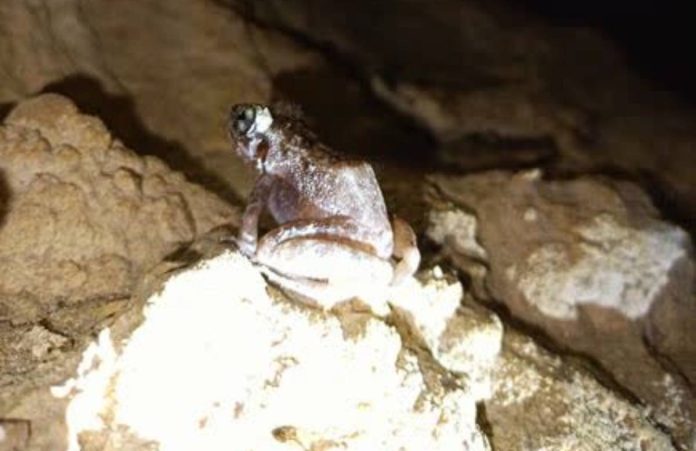
ILOILO — The Municipality of Carles has placed the spotlight on the survival of the critically endangered Gigantes limestone frog — a species found nowhere else on Earth — as officials warn that quarrying, deforestation, and unmanaged tourism could threaten the fragile ecosystem where the rare amphibian lives.
The call for protection came as Carles marked World Wildlife Day on March 3 by highlighting the conservation importance of Platymantis insulatus, which exists only in the limestone forests and cave systems of the Gigantes Islands.
First described in 1960 by herpetologists Walter C. Brown and Angel C. Alcala, the frog’s scientific name “insulatus”, derived from the Latin word for “isolated”, reflects its geographic confinement to the island ecosystem. Because of its extremely limited distribution and continuing threats to its habitat, the species is listed as Critically Endangered on the International Union for Conservation of Nature (IUCN) Red List.
Honey Lou Talidano, the municipal environment and natural resources officer-designate of the local government of Carles, said the Gigantes limestone frog demonstrates how geographic isolation shapes biodiversity.
“Ang Gigantes Islands are geographically separated from the mainland. Over time, this frog evolved as a unique species that exists only here,” Talidano explained. “It is adapted specifically to limestone forests and cave ecosystems. Indi tanan nga lugar may amo sini nga habitat, so naturally limited gid ang ila distribution.”
Unlike many amphibians, the Platymantis insulatus does not undergo a tadpole stage. Instead, it reproduces through direct development, meaning the eggs hatch directly into miniature frogs. This makes moist limestone caves and forests essential to their survival.
“Because they do not pass through a tadpole phase, they need damp, stable environments for reproduction,” Talidano said. “That dependence on a very specific habitat is one of the reasons why they are rare and highly vulnerable.”
Talidano said there is no recent comprehensive study confirming a significant increase in the frog’s population. Observations suggest the species remains present in parts of the islands, but its numbers are naturally limited because it is endemic to the island group.
“Gamay lamang ang ila distribution. Natural nga indi gid man damo ang ila numero,” she said. “Wala pa klaro nga ebidensya nga naga-damo gid ang ila populasyon. We consider them stable but limited — and very vulnerable to disturbance.”
She warned that environmental disturbances could easily damage the fragile limestone karst ecosystem where the frog thrives.
“Kun may pagbag-o sa palibot — pareho sang pagkalbo sang kagulangan ukon pagdisturbo sang mga kuweba — dako dayon ang epekto sa ila,” Talidano stressed.
To strengthen conservation efforts, the local government of Carles has declared the Gigantes limestone frog a flagship species through a municipal resolution, aimed at reinforcing its protection and raising public awareness about biodiversity conservation.
Talidano said habitat preservation remains the primary strategy.
“Ginaprotektahan naton ang limestone forests kag mga kuweba nga amo gid ang ila puluy-an kag lugar sang reproduction. We also coordinate closely with the Department of Environment and Natural Resources (DENR) for biodiversity monitoring and enforcement of environmental laws,” she said.
The DENR assists in monitoring activities and in the classification of caves to determine appropriate protection levels.
Talidano also cited the role of Project Palaka, established in 2015 as the country’s first ex-situ conservation initiative for native amphibians, which once focused on conserving the Gigantes limestone frog.
The project, however, ceased operations in 2025 due to funding and operational challenges.
“Ang conservation efforts may malawig pa gid nga dalanon nga pagalakton, especially at the LGU level because kulang pa kami sa technical experts,” she admitted. “But bisan amo sina, nagahimo kami sang gamay pero padayon nga mga tikang para sa ila proteksyon.”
Talidano emphasized that public perception remains a challenge in wildlife conservation.
“May ara gid naga-siling nga ‘paka lang na, damo man kita sina diri.’ But if we truly understand them, we will realize that they are not ordinary frogs,” she said. “The Platymantis insulatus is an important bio-indicator. It tells us that our biodiversity is alive, healthy, and functioning.”
“Every species — halin sa pinakagamay tubtob sa pinakadako nga tinuga — may bili kag may papel sa pagmintinar sang balanse sang kalibutan,” Talidano added. “Protecting this small frog means protecting our forests, our caves, and ultimately, our future.”/PN