

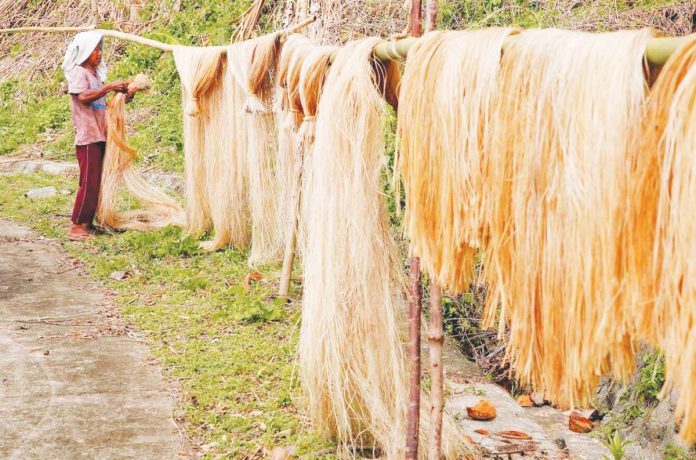
THE DEPARTMENT of Agriculture (DA), through the Philippine Fiber Industry Development Authority (PhilFIDA), has partnered with the Department of Labor and Employment (DOLE) to speed up the rehabilitation initiative in the Bicol Region after Super Typhoon “Uwan” devastated 55,198 hectares of abaca farms.
“In all, the typhoon wiped out an estimated 7,492.90 metric tons of fiber valued at more than P38 million. For many farmers still clawing back from the impacts of last year’s typhoons ‘Pepito’ and ‘Kristine,’ the destruction was a crushing setback,” the DA said.
PhilFIDA’s latest Crop Damage Report showed the extent of the destruction, with 1,402 hectares slightly damaged, 18,097 hectares moderately damaged, and a staggering 35,699 hectares heavily damaged.
Agriculture Secretary Francisco Tiu Laurel Jr. said Bicol is the country’s abaca fiber or Manila hemp powerhouse, and introduced this to the world.
“We owe it to our abaca farmers to help them recover quickly and rebuild stronger. Their resilience fuels rural economies, and we will stand with them every step of the way,” he said.
Tiu Laurel underscored the importance of Bicol to the abaca industry, contributing nearly one-third of national abaca production, with Catanduanes contributing at least 82 percent of the country’s output.
More than 56,000 hectares of abaca fields and over 24,000 growers rely on the crop as their primary source of income, he said.
To speed up recovery, the DA–PhilFIDA and DOLE partnership is activating a labor-intensive rehabilitation program through the DOLE Tulong Panghanapbuhay sa Ating Disadvantaged/Displaced Workers cash-for-work scheme.
Under the initiative, 23,619 farmers will be mobilized to clear debris, trim damaged stalks, rehabilitate surviving plants, and replant uprooted or severely weakened abaca.
“Replanting density will depend on the level of damage: 400 suckers per hectare in severely hit farms, 200 in moderately affected areas, and 100 in slightly damaged zones,” the DA said, highlighting the importance of integrating farmers’ protection into the program.
It added: “Before fieldwork begins, each beneficiary will receive protective long-sleeved clothing, a cap, and a one-year personal accident insurance package from PCIC (Philippine Crop Insurance Corp.).”
PhilFIDA technicians will conduct field validation to map damaged sites, verify losses, and document on-ground conditions, which are requirements for DOLE’s release of cash-for-work payments.
After replanting, joint inspection teams composed of PhilFIDA staff, LGU agriculture offices, and barangay agriculture committees will assess survival rates of replanted suckers before final incentives are issued.
Farmers will receive cash incentives based on farm conditions, with P3,000 per hectare for slightly damaged farms, P5,000 for moderately affected areas, and P10,000 for heavily damaged lands.
Tiu Laurel said the government aims to restore at least 4,505.81 hectares of abaca farms within three months with the aim of stabilizing the industry and helping thousands of Bicolano families rebuild their livelihoods. (PNA)