



ILOILO — Sometimes, the biggest obstacle standing between a learner and an education is not a difficult examination or a complicated lesson.
Sometimes, it is an empty stomach.
Jona Tamonan Tabaldo learned this during an afternoon review session when several of her learners quietly told her they were going home. They wanted to stay. They wanted to study. But they had no money for lunch, and hunger was making the decision for them.

So Tabaldo did something that would never appear in a teacher’s lesson plan: she reached into her own pocket and bought them food.
“They were eager to learn and wanted to stay for the review, but because they were hungry, they decided to go home. But as a teacher, I have tried to provide lunch for my learners so they can attend the afternoon review without worrying about going hungry,” she said.
“That experience made me realize that, for some learners, basic needs can become a barrier to education. I felt sad knowing that their willingness to learn was there, but their situation made it difficult for them to stay,” she added.
That simple act captures the kind of teaching Tabaldo has embraced — one that extends far beyond books, blackboards and classroom walls.
At 35, Tabaldo is a Teacher IV and Alternative Learning System (ALS) teacher assigned in Mandurriao, Iloilo City. A resident of Barangay Teniente Benito in Tubungan, Iloilo, she has spent nearly eight years helping people for whom the traditional school system did not work — or whom circumstances forced to leave it behind.
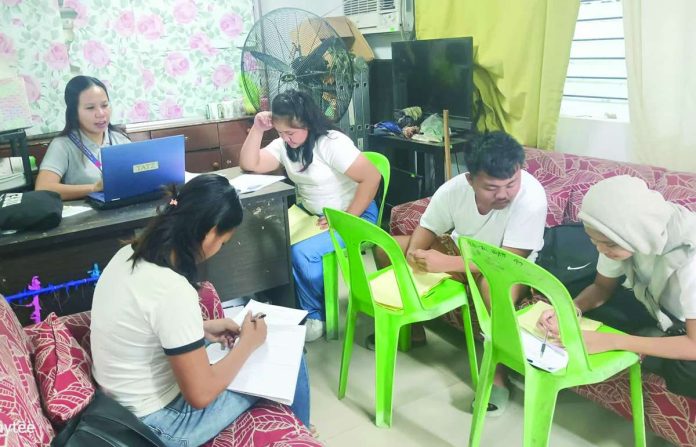
Her learners include construction workers and delivery riders trying to fit education around their jobs, a young mother dealing with the demands of early parenthood, out-of-school youth hoping to get their lives back on track, and older adults finally pursuing an education they once had to abandon.
For them, Tabaldo is more than someone who teaches English, Mathematics, Science and Filipino.
She is part teacher, counselor, motivator and, occasionally, provider.
And her classroom can be almost anywhere.
WHERE THE LEARNERS ARE
Tabaldo brings ALS education to the Mandurriao barangays of Airport, Bolilao and Hibao-an Norte while also teaching at Bakhaw Integrated School.
The learning environment is far removed from the conventional image of neat rows of desks filled with students of roughly the same age.
ALS learners come from different generations and vastly different circumstances. Some work. Some have families to support. Some struggle financially. Others have spent years away from school.
What binds them together is the desire to try again.
“For me, teaching is more than just a job; it is both a passion and a calling,” Tabaldo reflected.
“Teaching in the Alternative Learning System gives me a deep sense of purpose because I have the opportunity to help learners who were unable to continue their formal education,” she added.
“Being an ALS Teacher allows me to help learners who may have had difficulties continuing their formal education. I feel fulfilled when I see my learners gain confidence, understand a lesson, develop new skills, and believe in their own ability to achieve their goals,” she stressed.
But bringing education closer to these learners also means confronting the realities that pushed many of them out of school in the first place.
Some must choose between attending a learning session and reporting for work. Others carry family responsibilities. Financial difficulties can make even transportation, food and basic learning materials difficult to afford.
Technology and proper educational facilities are not always readily available. Some sessions must be held in makeshift or community spaces where noise, inadequate infrastructure and limited room can make learning difficult.
“There are times when learners face challenges such as financial difficulties, lack of learning resources, or other responsibilities that affect their attendance. Being able to support them and help them stay motivated makes my work meaningful,” she said.
For Tabaldo, these are not reasons to give up on a learner.
They are reasons to find another way.
A CHILDHOOD GAME BECOMES A CALLING
Long before she entered the profession, there were already clues about where Tabaldo would eventually find herself.
Like many children, she played “teacher-teacher,” gathering playmates and pretending to teach them Mathematics and the alphabet.
Yet becoming a teacher was not originally her first career choice.
Fascinated by science, she enrolled in Pharmacy at the University of San Agustin. Half a semester was enough for her to realize that she was pursuing a path that did not truly belong to her.
She shifted to Bachelor of Elementary Education, major in General Education, at the Western Visayas College of Technology, now Iloilo Science and Technology University, graduating in 2013.
Teaching, she eventually realized, had always been around her. Aunts and cousins who were educators had quietly provided examples of what the profession could mean.
“They influenced me through their dedication, patience, and passion for helping others, especially the learners. These experiences made me realize that teaching is not just about sharing knowledge—it is also about inspiring, guiding, and making a positive difference in the lives of others,” Tabaldo told Panay News in an interview.
Her professional journey began in 2015 as a contractual teacher at a parochial school in Tubungan.
Then, in 2018, she entered the Department of Education’s Alternative Learning System and was assigned to Bakhaw Integrated School.
There, teaching took on a different meaning.
“As I started working as a teacher, I realized that teaching was more than just a way to earn a living. I found fulfillment in helping learners understand new things, guiding them through challenges, and seeing their progress. My family’s encouragement gave me the confidence to take the first step, while my experiences as a teacher strengthened my passion for the profession,” she stressed.
WHEN TEACHING BECOMES PERSONAL
ALS has taught Tabaldo that a learner cannot always leave life’s problems outside the classroom.
Poverty follows them inside.
So do work pressures, parenthood, family obligations, missed opportunities and sometimes years of believing that education is no longer possible.
That is why small victories matter.
A learner finally understanding a difficult lesson matters. Someone gaining enough confidence to participate matters. A working student finding time to attend a session matters. An adult returning after years away from education matters.
“What I value and love most about the teaching profession is the opportunity to make a meaningful difference in the lives of my learners. As an ALS Teacher, I have the privilege of helping individuals who may have experienced challenges in continuing their education. It is fulfilling to see them regain their confidence, become motivated to learn, and continue working toward their dreams,” she remarked.
For Tabaldo, education is therefore not simply about completing modules or passing assessments. It is also about convincing people who have experienced setbacks that those setbacks do not have to determine the rest of their lives.
“I also value the relationships I build with my learners. Teaching allows me to understand their experiences, listen to their struggles, and encourage them to believe in themselves. Sometimes, even small acts of support can make a big difference in their willingness to continue learning,” she shared.
“Most of all, I love knowing that my work can provide hope and a second chance for learners to improve their lives through education. For me, teaching is not only a profession but also a meaningful responsibility and an opportunity to serve my community,” Tabaldo emphasized.
THE LESSON BEYOND THE BOOKS
There is perhaps no better measure of an ALS teacher’s work than persistence.
Not every day produces a dramatic breakthrough. There are difficult sessions, absences, resource shortages and learners whose circumstances constantly threaten to pull them away from education.
But then someone progresses.
Someone achieves something once thought impossible.
Someone simply says “thank you.”
“There are days when teaching can be challenging, but every learner’s progress, every achievement, and every “thank you” makes the journey meaningful. These moments remind me why I chose to serve as an educator,” Tabaldo said.
Her message to young people considering the profession reflects the lessons she herself has learned outside the boundaries of a conventional classroom.
“Pursue the profession with dedication, patience, and a genuine heart for helping others. Teaching is not always easy… but never stop learning. Be patient with your learners, believe in their potential, and treat them with kindness and respect. Your influence as a teacher may leave a lasting impact on a learner’s life, even in ways you may not immediately realize,” she said.
As the education community marks Teacher’s Day, Tabaldo’s story offers a reminder that some of the most consequential teaching happens where classrooms are imperfect, resources are scarce and learners arrive carrying burdens heavier than their school bags.
It happens in barangay learning centers and community spaces.
It happens after a long day of work.
It happens when a young mother decides that having a child does not mean surrendering her own future.
And sometimes, it happens over a simple meal bought by a teacher who understands that before a hungry learner can concentrate on tomorrow, someone may first have to help that learner get through today.
“On this Teacher’s Day, I celebrate not only the teaching profession but also the purpose behind it: “to empower learners, build hope, and open doors to better opportunities. To all my fellow teachers, especially my fellow ALS educators, thank you for your dedication, patience, and passion. May we continue to teach with heart, serve with purpose, and inspire one learner at a time. Happy Teacher’s Day to all educators!,” she said.
For Tabaldo and the learners she serves, education is not merely about where someone begins.
It is about being given the chance to begin again./PN