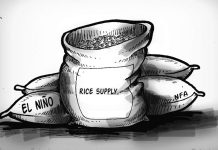




THE DEPARTMENT of Agriculture (DA) in Western Visayas is right to urge local governments to replicate Iloilo City’s ordinance requiring restaurants, fast-food chains, canteens, and carinderias to offer half-cup rice servings.
In a country where millions struggle to put food on the table, wasting rice is an insult to hunger, a betrayal of farmers’ sacrifices, and a national disgrace.
According to the DA, every Filipino wastes an estimated two spoonfuls of rice daily – equivalent to 9.69 kilograms annually.
Two spoonfuls may seem insignificant, but multiplied by millions of Filipinos, they become a staggering national loss – that is collectively throwing away an astonishing 542,477.6 metric tons of rice each year, enough to feed 5.17 million people for an entire year.
Let that figure sink in. While countless families worry about their next meal, enough rice to nourish millions ends up in the garbage. The tragedy is not merely that food is wasted, but that such wastefulness has become disturbingly ordinary.
Iloilo City deserves commendation for pioneering half-cup rice servings – a practical initiative. It proves that addressing food wastage does not always require expensive programs or grand government pronouncements. Sometimes, meaningful reform begins with something as simple as serving less rice.
The principle is straightforward: Take only what you can eat. Order more if necessary. Waste nothing.
The half-cup option does not deprive anyone of food. Instead, it discourages excessive servings while allowing consumers to save money. More importantly, it recognizes that every grain represents the sweat, sacrifices, and hard work of Filipino farmers.
There is also a glaring irony in the country’s food security problem. Government struggles to increase rice production, improve agricultural productivity, and ensure adequate supplies, yet consumers collectively waste enough rice to feed millions.
What good is producing more rice if we remain careless about the rice already on our plates?
Of course, reducing wastage cannot replace the government’s responsibility to address inadequate irrigation, high production costs, postharvest losses, and other agricultural problems. But food conservation must become an equally important part of the country’s food security strategy.
Other local governments in Western Visayas should follow Iloilo City’s example. However, ordinances must be accompanied by strict implementation, public education, and genuine behavioral change. A law that exists only on paper cannot save a single grain.
Schools, households, restaurants, and government offices must also embrace responsible rice consumption.
Ultimately, food security begins not only in the rice fields but also at the dining table.
Every grain saved honors a farmer. Every plate emptied respects the value of food. Every spoonful spared from the garbage is a small victory against hunger.