



ILOILO City – Western Visayas must break away from fragmented, city-centered economic development and transform its provinces and cities into an interconnected network of specialized growth hubs to accelerate industrialization, attract investments and spread economic opportunities across the region, the Department of Economy, Planning, and Development (DEPDev) said.
DEPDev Undersecretary Carlos Bernardo O. Abad Santos emphasized that the region’s economic future depends on stronger cooperation among local government units, strategic infrastructure investments and the development of industries that complement rather than compete with one another.
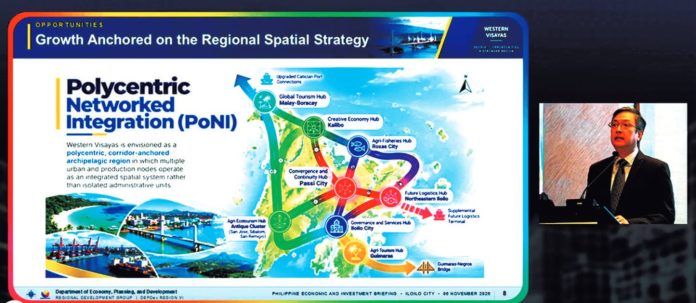
Speaking at the Philippine Economic and Investment Briefing (PEIB) in Iloilo City on November 6, Abad Santos unveiled the Polycentric Networked Integration (PoNI) Framework, a regional development strategy designed to distribute economic growth beyond major urban centers.
“This recognizes Western Visayas should not depend on one dominant urban center to drive regional growth,” said Abad Santos.
Under the proposed framework, provinces and cities would assume specialized economic roles based on their resources, industries and competitive advantages, while infrastructure and transport corridors would connect them into a unified regional economy.
“Connected by infrastructure and economic corridors, these centers form an integrated ecosystem where industries can specialize, collaborate, and to scale. The objective is to allow these centers to specialize, complement one another, and operate as an integrated regional economy,” Abad Santos said.
SPECIALIZED ECONOMIC HUBS
Under the development blueprint, Iloilo City would serve as a governance and services hub, while Passi City would become a convergence and continuity hub linking economic activities across Panay.
Northeastern Iloilo is envisioned as a future logistics hub, positioning it to support the movement of agricultural products, industrial goods and other commodities.
In Aklan, Malay-Boracay would function as a global tourism hub, while Kalibo would specialize in the creative economy.
Roxas City in Capiz would serve as an agri-fisheries hub, while Guimaras would focus on agri-tourism.
The Antique cluster comprising San Jose, Sibalom and San Remigio would be developed as an agri-ecotourism hub.
For Guimaras, DEPDev identified the development of a supplemental fish and logistics terminal as a strategic investment to improve market access, product distribution and supply chain efficiency.
INDUSTRIAL GAP THREATENS GROWTH
Beyond improving cooperation and connectivity, DEPDev warned that Western Visayas must address its structural economic weakness — the underdevelopment of its manufacturing and processing industries.
Abad Santos identified this weakness as the region’s “missing middle,” referring to the insufficient industrial capacity needed to transform agricultural and fishery products into higher-value commodities.
Despite the region’s strong agricultural production and economic performance, inadequate processing facilities continue to limit opportunities for value addition, industrial expansion and greater economic returns.
DEPDev consequently identified the strengthening of local manufacturing, the expansion of value-adding industries and the establishment of stronger connections between primary producers and processing enterprises as major development priorities.
The agency also emphasized the need to address unstable electricity supply and power availability, which remain critical considerations for industrial development and investment competitiveness.
INFRASTRUCTURE KEY TO INTEGRATION
To turn the proposed economic network into reality, DEPDev underscored the importance of major infrastructure projects that would improve connectivity, agricultural productivity and regional resilience.
Among the priority investments is the Jalaur River Multipurpose Project, designed to provide year-round irrigation, increase agricultural production, generate hydroelectric power and strengthen water security.
The Panay River Basin Integrated Development Project was also identified as a major initiative for flood mitigation, agricultural support and resource management in Capiz and surrounding areas.
Another crucial undertaking is the Panay-Guimaras-Negros Island Bridges Project, which is expected to improve the movement of people, goods and services among the islands and strengthen interregional economic integration.
DEPDev said these infrastructure investments, combined with industrial expansion and closer cooperation among local economies, could improve productivity, widen market access and strengthen Western Visayas’ competitiveness./PN