
ILOILO – From mountains of discarded tarpaulins to handmade wallets and grocery bags, Iloilo province is transforming election trash into tools for both livelihood and environmental protection.
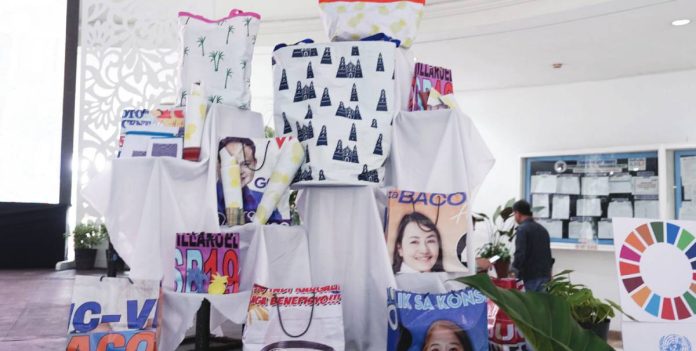
The provincial government yesterday launched its “Weave Out Waste (WOW) Limpyo Iloilo” initiative, a pioneering circular economy project that recycles post-election plastics into marketable products.
Spearheaded by the Provincial Government Environment and Natural Resources Office (PGENRO) in partnership with the United Nations Development Program (UNDP) and funded by the Coca-Cola Foundation, the project aims to upcycle plastic waste into consumer goods while creating green jobs and sustainable enterprises.
“It is the high-time that we should put into our governance and local administration policies to manage our waste. It is a problem we can address if we have the will or determination to put up the policies and the programs, projects with solid waste management in our municipalities, province, and in the city,” said Provincial Administrator Raul Banias, representing Gov. Arthur Defensor Jr. at the Capitol launch.
Tackling post-election trash
The program was designed in response to the 49,000 kilograms of waste collected in May during the Limpyo Eleksyon 2025 campaign, more than half of which were plastics. Tarpaulins made up 34 percent of this volume, followed by flexible plastics at 16 percent.
By converting this waste into raw material for local enterprises, Iloilo is positioning itself as a model for circular economy practices in the Philippines.
“Weave Out Waste” emphasizes not only environmental protection but also livelihood generation, particularly for marginalized groups.
Pilot LGUs and local innovations
Four municipalities and cities – Pototan, Dumangas, Banate, and Passi City – have been selected as pilot local government units. Each offers unique strengths: Dumangas’ community-driven plastic barter programs, Pototan’s push to become a commercial hub, Banate’s agri-fishery supply, and Passi City’s balance of economic growth with green jobs.
Training workshops held from September 8 to 9 introduced 40 participants, including artisans and Gender Equality, Disability, and Social Inclusion (GEDSI) groups, to design thinking, sustainability, and upcycling skills. They began prototyping laundry bags, wallets, placemats, and other practical products.
“This will ensure that the upcycled products meet the demand of target markets. The engagement extends to the informal waste sector, women’s groups, and local organizations that support vulnerable populations. This outreach is crucial for building an inclusive economy that provides equal opportunities for all community members,” said Dr. Selva Ramachandran, UNDP Philippines Resident Representative.
A step toward sustainability
Governor Defensor has vowed to integrate circular economy principles into local governance, starting with the WOW program and extending to future initiatives.
The project also aligns with the Philippine Plastics Circularity Project, which partners with LGUs nationwide to innovate on waste management.
By turning electoral waste into community enterprise, Iloilo province is proving that trash can be reimagined as both livelihood and solution, setting a precedent for other regions facing the dual challenge of pollution and unemployment./PN