



QUEZON City — Before the music began and before the students stepped onto the stage, the message had already reached hundreds of screens.
For ten days, students of the Eugenio Lopez Jr. Center for Media Arts Senior High School (ELJCMASHS) shared Rotary’s End Polio Now campaign across social media, encouraging classmates, families, and friends to learn about one of the world’s longest-running humanitarian efforts. By the time the curtain rose, the audience was no longer watching a performance alone—they were witnessing the culmination of a campaign that had already sparked conversations beyond the campus.
That seamless transition from digital engagement to live community participation became the defining feature of Unite in Motion: End Polio Now, an integrated public image initiative of the Rotary Club of Roosevelt that demonstrated how youth, education, community partnerships, and media can work together to advance a global cause.
Held in partnership with ELJCMASHS and supported by Panay News as media partner, the campaign invited students to become advocates rather than spectators. Over ten days, they explored Rotary’s humanitarian mission while producing and sharing campaign content through Facebook and Instagram. The initiative culminated in a dance presentation where music, movement, and storytelling transformed awareness into participation.
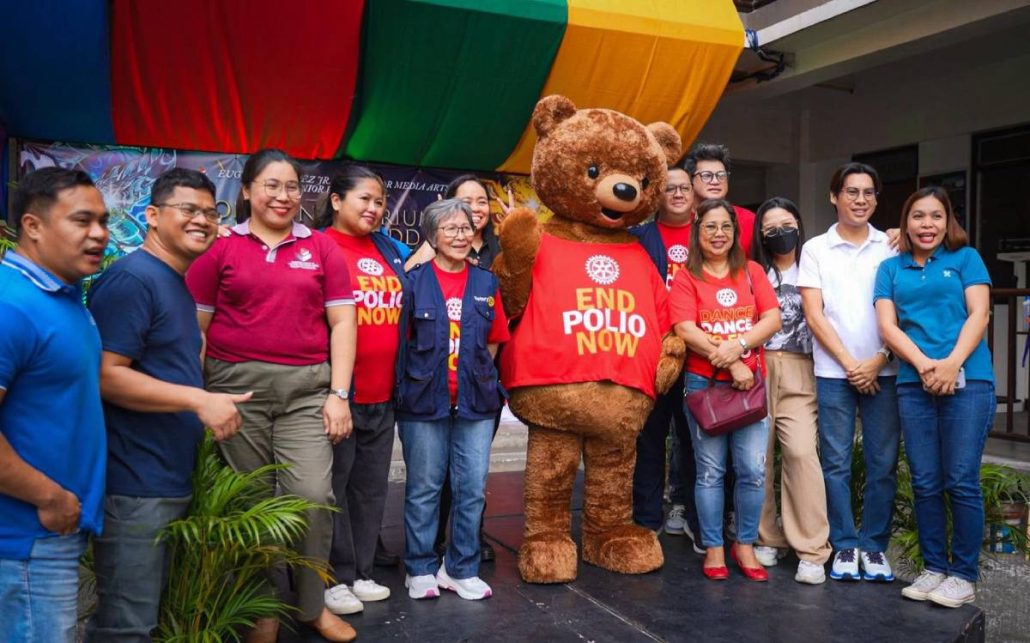
Behind the performance was a humanitarian mission that Rotary has championed for more than four decades.
For more than 45 years, Rotary has worked to eradicate polio worldwide. Its first vaccination project was conducted in the Philippines in 1979, paving the way for Rotary to become a founding partner of the Global Polio Eradication Initiative in 1988. Since then, global polio cases have declined by 99.9 percent. Rotary has contributed more than US$2.9 billion toward eradication efforts, helping protect over three billion children in 122 countries from a disease that is preventable through vaccination.
Those achievements have made polio unfamiliar to many young people today—a remarkable success in itself. Yet they also underscore why continued public awareness remains essential. A disease that is no longer visible can easily become a cause that is forgotten.
The campaign was intentionally designed to bridge the digital and physical worlds. Social media created awareness before the event, while the live performance transformed that awareness into shared community action. Together, the two platforms allowed the campaign to educate audiences before the performance, engage them during the event, and continue the conversation long after the final applause.
The integrated approach proved effective. Across Facebook and Instagram, the campaign generated 18,000 impressions, 1,400 engagements, and 4,200 video views, achieving an 18.5 percent engagement rate. More importantly, students became ambassadors for the campaign, bringing conversations about End Polio Now into their classrooms, homes, and online communities.
Perhaps the campaign’s greatest success could not be measured by analytics.
It was reflected in the students themselves.
What began as a school activity evolved into an opportunity to use their creativity for a humanitarian cause. Dance became advocacy. Social media became education. Young people became voices for a global mission that many had never encountered before.
The initiative also demonstrated the strength of collaboration. ELJCMASHS nurtured young leaders eager to make a difference. Rotary connected local participation to a global humanitarian mission. Panay News helped extend the story beyond the school community, demonstrating how responsible journalism can connect local initiatives with issues of global significance.
Today, communities discover stories in many ways—through newspapers, social media, schools, and community events. Unite in Motion: End Polio Now showed that public awareness is strongest when these platforms complement one another, allowing important messages to reach people wherever they are.
Today, many young people have never witnessed the effects of polio. That is one of humanity’s greatest public health successes.
Yet the responsibility to finish the fight now belongs to a new generation.
Through Unite in Motion, students proved that advocacy is no longer confined to classrooms, community halls, or social media. It flourishes when creativity inspires conversation and when local communities embrace global causes as their own.
Rotary’s fight against polio began with vaccines. Its final chapter may well be written by the young people who choose to keep the story alive./PN