


ILOILO City – As Typhoon Tino whipped through Western Visayas in the morning of November 4, 83-year-old Norma Molina Malte of Barangay Tabuc Suba, Jaro, performed a ritual that she has done since her youth — one rooted in an old Ilonggo belief about calming storms.
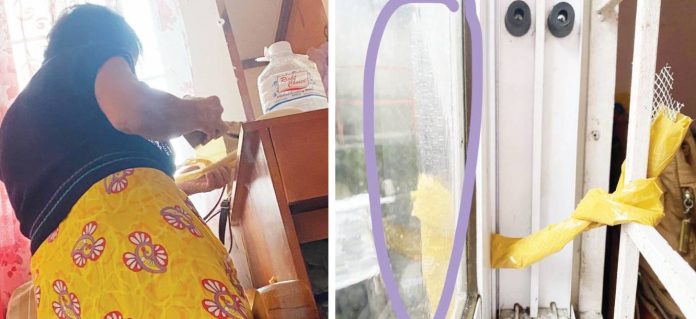
In a series of photos taken inside her modest home, Norma is seen sitting by her bedroom window, wrapping a kitchen knife in yellow duct tape before carefully fastening it to the iron grill facing the outside. The knife’s blade points outward, seemingly poised to “cut through” the invisible chaos of the storm.
It took Norma about 10 minutes to secure the knife in place, a task she carried out with quiet determination while wind rattled the curtains and rain lashed the windows.
According to her, “During strong typhoons, when the wind grows fierce and restless, we place a knife outside the house to ‘cut’ or ‘break’ the circular motion of the wind. It helps calm the storm or lessen its force.”
An Old Belief Passed Down Through Generations
Norma’s act echoes a folk tradition shared in many parts of the Philippines and other Southeast Asian countries — a belief that certain household objects, especially sharp metal tools like knives, can symbolically “slice” through dangerous weather. She learned the practice from her own father.
Cultural scholars note that such rituals are a blend of indigenous animist practices and Catholic folk beliefs, where objects are believed to carry protective energy. In many Visayan and Tagalog households, residents still place knives, bolos, or scissors by doors or windows during typhoons to ward off destructive winds or lightning.
In a 2019 feature by the National Museum of the Philippines, similar practices were described as part of “weather charms” — tangible acts of faith rooted in rural cosmology, often carried out by elders who witnessed the fury of typhoons long before modern forecasting existed.
Even in social media threads and community pages, people continue to share these customs. Some say the blade “frightens” the storm spirits; others believe it “cuts the eye of the typhoon” — a poetic metaphor for disrupting nature’s spiral of destruction.
Faith, Habit, and Hope
To outsiders, it may seem like mere superstition. But for people like Norma, it is an act of care and control — a way to protect her home and loved ones when all she can do is wait and pray.
As she finished tying the yellow plastic around the knife, she murmured a quiet prayer. “Wala man malain if magpati kita even if it seems ‘impossible’.”
In that small act — a knife tied to a window, a grandmother’s hands trembling with both age and faith — is a story of how Filipinos face every storm: with belief, resilience, and the hope that even the fiercest wind can be tamed by love and tradition./PN