


By MA. THERESA LADIAO
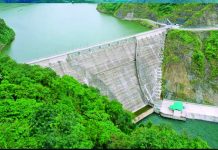
ILOILO City — Despite holding 146 million cubic meters of water that could help protect Iloilo’s agricultural sector from a looming super El Niño, the high dam of the Jalaur River Multi-Purpose Project Stage II (JRMP II) in Calinog, Iloilo can currently irrigate only about 500 hectares of farmland, leaving many farming communities without direct access to the massive reservoir’s water supply.
The National Irrigation Administration (NIA) acknowledged that while the dam has accumulated substantial water reserves, its unfinished irrigation network remains a major obstacle to extending the project’s benefits to more farmers who could face prolonged dry conditions and declining water supplies.
As of October 20, the dam’s water level had reached 175 meters above sea level, equivalent to approximately 146 million cubic meters of stored water.
However, NIA information officer Steve Cordero stressed that having sufficient water in the reservoir does not necessarily mean it can be delivered to all agricultural communities.
“Yes, the water is already available at the Jalaur High Dam. However, that answer needs context because the project is still undergoing implementation, particularly its irrigation components,” Cordero said.
“The dam can already provide water, but not all areas can benefit yet because we are still completing the entire irrigation component. For selected areas, the answer is yes, but for all areas, not yet,” he added.
The situation underscores a critical challenge confronting Iloilo’s agricultural sector as the province braces for the possible effects of super El Niño: a massive reservoir already holding millions of cubic meters of water, but an incomplete distribution system preventing much of that resource from reaching farms.
ONLY 500 HECTARES COVERED
According to Cordero, the completed irrigation facilities currently serve approximately 500 hectares of agricultural land in Calinog, particularly in barangays Aglibacao, Bado and Lonoy.
Farmers in these areas can already benefit from the dam’s water supply, including during the dry-season cropping period when rainfall becomes insufficient to sustain agricultural production.
The availability of irrigation water has even enabled some farmers to expand their planting activities beyond their usual cropping schedules.
“One success story of the project’s irrigation development component is that farmers under the Agbato Calinog Irrigators Association Inc., particularly in Barangay Bado, were able to undertake a third cropping cycle for the first time because water became available in their area,” Cordero said.
The achievement demonstrates the dam’s potential to improve agricultural productivity by allowing farmers to cultivate their land more frequently through reliable irrigation.
However, the same opportunity remains unavailable to farming communities whose irrigation canals and related infrastructure have yet to be completed.
Without operational distribution facilities, these farmers must continue relying on existing irrigation systems and other water sources, which could become increasingly vulnerable during prolonged periods of insufficient rainfall.
The limited coverage also highlights the urgency of completing the remaining irrigation components before severe dry conditions place additional pressure on the province’s agricultural production.
MOROBORO DAM GETS SUPPORT
Despite the limitations of its irrigation network, the Jalaur high dam can also help agricultural communities beyond its directly connected service areas by augmenting the water supply of Moroboro Dam in Dingle, Iloilo.
Cordero explained that water released from the upstream Jalaur high dam flows downstream toward Moroboro Dam, helping replenish the latter’s supply for farmers dependent on its irrigation system.
NIA previously implemented this arrangement during the dry season when agricultural areas experienced insufficient irrigation water.
“We released water from the high dam in Calinog, and that water helped augment the supply at Moroboro Dam in Dingle. This happened when farmers were planting during the height of summer and water was insufficient,” Cordero said.
The arrangement provides another means of maximizing the reservoir’s water supply while the remaining irrigation infrastructure is under construction.
However, future releases must still consider reservoir storage levels, downstream water requirements and the operational needs of the irrigation system.
POTENTIAL WATER SOURCE FOR ILOILO CITY
Beyond agriculture, the Jalaur high dam has also emerged as a possible emergency water source for Iloilo City should the anticipated dry conditions worsen existing water supply challenges.
The city government has raised the possibility of transporting water from the Calinog reservoir using trucks and tankers if existing water suppliers become unable to meet demand.
NIA has expressed openness to discussing the proposal but has not yet received formal coordination from the city government.
Cordero previously pointed out that transporting water over the considerable distance between Calinog and Iloilo City could entail substantial expenses.
Moreover, the dam’s primary purpose is agricultural irrigation, with existing water rights intended for that use.
Any proposal to utilize its stored water for other purposes would therefore require further coordination, feasibility assessments and consideration of operational requirements./PN