



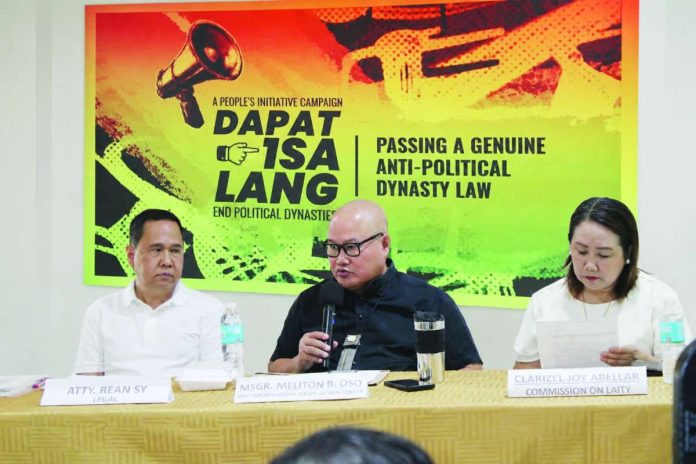
ILOILO City – The Archdiocese of Jaro is mobilizing its parishes, lay organizations, youth and volunteers across its jurisdiction to help gather millions of signatures for a nationwide People’s Initiative seeking to enact an anti-political dynasty law directly through Filipino voters.
The move gives the “Dapat Isa Lang” campaign a potentially powerful grassroots network in Western Visayas as proponents race to collect signatures equivalent to at least 10 percent of the country’s registered voters, including at least three percent of registered voters in every legislative district.
The archdiocese formally threw its support behind the initiative in a pastoral circular issued by Jaro Archbishop Midyphil Billones on September 30.
The initiative seeks to restrict simultaneous and successive candidacies and occupancy of elective positions by relatives within the fourth civil degree of consanguinity or affinity and impose a one-term cooling-off period before a relative can succeed an outgoing official.
It would also limit a political family to one member holding a national elective position and one holding a local elective position at a time.
The campaign comes amid renewed national pressure to implement the constitutional prohibition against political dynasties.
Article II, Section 26 of the 1987 Constitution mandates the State to “guarantee equal access to opportunities for public service and prohibit political dynasties as may be defined by law.”
Billones, echoing the position of the Catholic Bishops’ Conference of the Philippines, said political power has increasingly become concentrated within families instead of being treated as a public trust.
“Have you ever felt like you are running helplessly in a circle and there’s no way out? … Politics has become a family business in the Philippines. It’s no longer about public trust, integrity, and competence, but power and influence that is largely handed down from one family member to the other,” Billones said.
In Iloilo, the Jaro Archdiocesan Social Action Center (JASAC), together with the Commission on Laity and legal and youth volunteers, will spearhead the grassroots campaign.
Monsignor Meliton Oso, JASAC director, said organizers want to complete the signature campaign by the end of the year or January 2027 and submit the petition to the Commission on Elections (Comelec) by the first week of February.
“Kon matipon ang tanan nga perma by December 31…goal naton nga ma-submit in the first week of February agud matagaan ang Commission on Elections sang six to seven months para mag-verify sang tanan nga signatures,” Oso said.
The campaign hopes to hold a referendum in 2027. If that timetable cannot be met, proponents are looking at having the proposed anti-dynasty measure submitted to voters alongside the 2028 elections.
Under the proposed measure, relatives up to the fourth civil degree would be covered by the restrictions. The proposal would also prohibit simultaneous candidacies by covered family members, position swapping and immediate succession by relatives.
The nationwide campaign is proceeding through both an online platform and face-to-face signature gathering.
The archdiocese plans to establish sign-up tables in parishes, particularly after Sunday Masses, to assist people who have difficulty using the online platform.
“This bill is called the People’s bill because it’s more comprehensive nga indi parehas sa Congress nga bill,” Oso said.
“May portal sila. Sa mga techy…sa mga kabalo sang technology, two to three minutes matigayon naton, pero sa mga indi, ga handom kami nga pagkatapos misa Dominggo at least ang kada parokya matigayon sang sign up tables,” Oso said.
The archdiocese will also tap students and Church organizations to broaden the campaign beyond parishes.
“Magasugod na ang amon nga trainings sa mga kabataan, unahon ang mga kabataan, mga instrument namon ang mga students nga manaog sa mga eskwelahan. Maga upod sa aton ang Commission on Youth, pero ang mas gaupod gid sa aton subong ang Commission on Laity ..para ipalab-ot sa mga nagakalain-lain nga sector,” Oso said.
The Dapat Isa Lang proposal seeks to use the People’s Initiative mechanism under Republic Act 6735, which allows voters to directly propose and enact legislation subject to constitutional and statutory requirements.
The campaign’s online signature platform was formally launched nationwide on September 30. The proposed law would cover relatives within the fourth civil degree and generally limit a family to one national and one local elective office at the same time.
The CBCP has likewise backed the People’s Initiative, describing it as a lawful and democratic means of pursuing the constitutional mandate against political dynasties.
In Jaro, the Church is framing participation around three calls to civic engagement: “Dapat Alam,” or understanding the issue and the proposed law; “Dapat Maki-Alam,” or becoming actively involved; and “Dapat Manindigan,” or taking a stand while protecting electoral participation against misinformation, coercion, vote-buying and intimidation./PN