



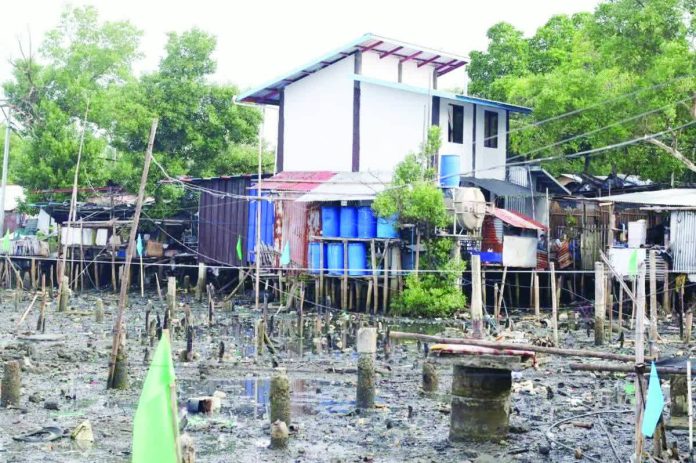
ILOILO City – The city government is tightening standards in identifying relocation sites for informal settlers in storm surge–prone coastal areas, stressing that landfilling and road network development will determine whether a site is safe and suitable for resettlement.
Atty. Peter Jason Millare, head of the Iloilo City Local Housing Office (ICHLO), said the city will no longer rush relocation projects without proper groundwork — a mistake that previously led to flooded housing sites.
“We don’t want to relocate people to purchased lots that remain unfinished without proper landfill. Otherwise, they will still suffer from flooding,” Millare emphasized.
The city is prioritizing the transfer of families living along the coastline from Fort San Pedro to Sto. Niño Norte in Arevalo district — areas identified as most vulnerable to storm surges and rising tides.
“We are discussing within the team that if possible, we should find land close to their current areas. If none is available, we are expanding in Barangay San Isidro, Jaro, which we are looking at for road network and landfill development,” he explained.
Millare noted that ensuring audit compliance adds another layer of difficulty to site preparation.
“The landfill is a challenge because the Commission on Audit (COA) has noted that if the program is purely for landfill, it may raise compliance issues. That’s why if we do landfill, it must go with development — either infrastructure or road network,” he said.
He admitted that many of the city’s relocation projects remain “lot-only,” resulting in houses made from light materials and communities that still resemble informal settlements.
“That’s why when you look at some relocation sites, they still look like informal settlements even if they are resettlement areas,” he observed.
Learning from past errors, the ICHLO is now coordinating with the City Environment and Natural Resources Office (CENRO), the Department of Public Works and Highways (DPWH), and the Iloilo Business Center (IBC) to source landfill materials from debris and construction surplus.
“We’ve been writing to these offices to ask if we can use their debris or excess materials for landfill in relocation sites. The raw materials we can buy now are too low compared to the city’s road level,” Millare said.
He underscored that the city’s objective goes beyond merely providing land to displaced families.
“The goal is not only to provide land but to ensure safe, livable, and sustainable communities for the relocated families,” Millare said.
The city government is expected to finalize the list of proposed relocation sites by early next year as part of its broader effort to strengthen disaster resilience and reduce coastal vulnerability./PN