

BACOLOD City – Environmental campaigners urged Negrenses to lead in reducing the use of hydrofluorocarbons (HFCs) in the country.
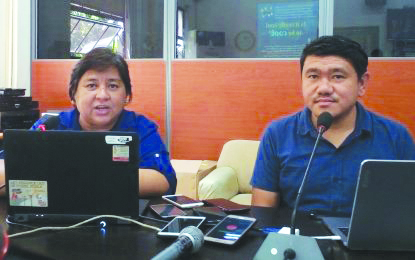
Christian Aid’s climate change advisor for Asia and the Middle East Jessica Dator-Bercilla and Climate Reality Project Philippines manager Rodne Galicha made the call during a press briefing on Friday.
Bercilla and Galicha did such amid efforts to ratify the Philippines’ accession to the Kigali Amendment, an addition to the Montreal Protocol which aims to reduce the production and consumption of ozone depleting substances to protect the earth’s fragile ozone layer.
The Kigali Amendment was ratified by at least 20 countries in 1987. To date, 37 states, excluding the Philippines, have ratified it.
“You are a champion of a lot of climate-related solutions. We appeal to you to lead the country in committing to reduce the use of HFCs and couple it with energy efficiency,” Dator-Bercilla told Negrenses.
HFCs are purely man-made substances commonly used as cooling agents for various purposes, like air conditioning, refrigeration systems, fire retardants, and solvents for cleaning products.
HFCs were found to have high global warming potential, a measure of how much heat the greenhouse traps in the atmosphere.
HFCs are responsible for only 1 percent of global warming, but a study published in 2013 showed that an accelerated global HFC phasedown can prevent a 0.5-degree Celsius of global warming by 2100.
This makes the HFC phasedown important to achieve the 1.5-degree Celsius target under the Paris Agreement, the campaigners said.
“The call is for phase down, not phase out. We are doing this gradually,” Galicha said.
He added that in the Philippines, the civil society is working with the Philippine Ozone Desk under the Department of Environment and Natural Resources’ Environmental Management Bureau to conduct the information campaign and lobby for accession.
Galicha said they have to obtain certificates of accession from the departments of trade, energy, and science and technology, as well as other concerned government agencies.
“These will be collated by the Department of Foreign Affairs and will be submitted to the Office of the President. The President will then send it to the Senate, which will approve the accession. The document will then be sent back to the President,” he explained.
After President Rodrigo Duterte decides to sign the accession, the document will be sent to the United Nations through a Philippine representative, Galicha added. (With a report from PNA/PN)