
JOURNALIST Frenchie Mae Cumpio is a member of a group of social activists and human rights defenders who were arrested in Tacloban City on Feb. 7, 2020. She and a companion, church worker Marielle Domequil, were charged with illegal possession of firearms.
In July 2020, murder and attempted-murder charges were filed against Cumpio, and in October 2021, the charge of terrorism financing was added to her case.
In October 2025, the Court of Appeals dismissed Cumpio’s civil forfeiture case related to terrorism financing, finding no evidence linking her to terrorist groups.
A few months later, the Regional Trial Court of Laoang dismissed the murder and attempted-murder charges against her.
In January 2026, her illegal firearm possession case was dismissed.
Allegedly, the military “planted” firearms and ammunition. However, both Cumpio and Domequil were convicted of terrorism financing by Judge Georgina Uy Perez and sentenced to 12 to 18 years in prison.
Cumpio’s defense team challenged her conviction on March 23 before the same judge, who made no decision on the charges or on granting bail. Until now, both women remain detained.
There were widespread shock and protests over this conviction, seen as repression of press freedom and a frame-up. Human rights groups and press freedom bodies condemn Cumpio and Domequil’s conviction and continued detention, with United Nations special rapporteur Irene Khan saying the charges appeared to be “in retaliation for [Cumpio’s] work as a journalist.”
Prior to her arrest, Cumpio covered alleged abuses of power perpetrated by the military and was red-tagged along with her colleagues.
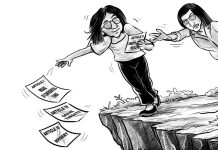
Observers say the terrorism financing charge against Cumpio and Domequil was fabricated, and their case was pursued to satisfy the Philippine government’s need to find suspects and to charge and convict them because the country is desperate to get off the gray list of the Financial Action Task Force (FATF).
Being on that list blocked international transactions of money transfers by Filipino tycoons suspected of money laundering and others of terrorist financing, and the government was doing little or nothing about it. FATF inspectors said the Philippines was under “increased monitoring due to deficiencies in their anti-money laundering and counter-terrorism financing (AML/CFT) systems.”
This is because some politicians, police and corrupt businessmen are very much into those crimes themselves, especially laundering stolen cash. They could not admit their guilt, and instead found suspects and charged them with the crimes to show the FATF they were compliant with international regulations to get the Philippines off its gray list.
The Department of Justice (DOJ) filed more charges against suspects using Republic Act (RA) 10168, or as The Terrorism Financing Prevention and Suppression Act of 2012, and got the courts to convict six more people. They were convicted on 114 counts of terrorism financing since the intensification of efforts began around 2024 to 2025. So, those community workers giving donations of food or money to alleviate poverty and hunger to any of the 14 million hungry Filipinos, victims of typhoons or poverty, could be branded as criminals.
Many other activists and nongovernmental organization workers have been charged with similar crimes, but not yet convicted. Some cases have been dismissed by just and good judges for lack of evidence, such as those against activists Fritz Labiano, Paul Tagle, and Jazmin Jerusalem. They were declared innocent.
But how many more innocent people were declared guilty to “appease” the FATF and open the doors to unimpeded international money transactions? (To be continued)/PN