



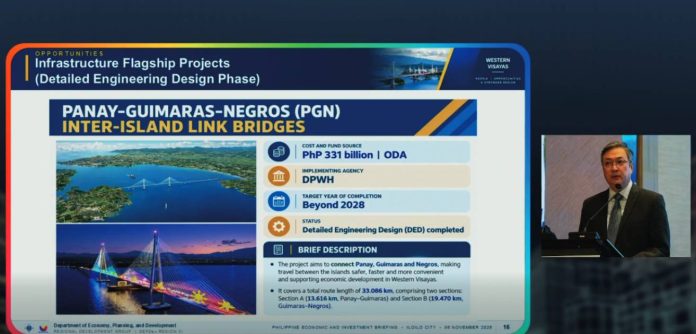
ILOILO City — The P331.59-billion Panay-Guimaras-Negros (PGN) Island Bridges Project could transform Western Visayas into a more competitive economic hub by integrating three island economies, slashing logistics costs and attracting investments, the Department of Economy, Planning, and Development (DepDev) said.
Undersecretary Carlos Bernardo O. Abad Santos described the massive infrastructure project as a potential game changer for regional economic growth, emphasizing that its benefits would extend far beyond faster travel between Panay, Guimaras and Negros.
“The bridges are arguably one of the most transformative connectivity investments being pursued in Western Visayas and even in the entire Visayas,” Abad Santos emphasized.
“The significance goes well beyond reducing travel time. It would help integrate 3 Island economies, expand access to market, and reduce logistic costs, and facilitate the movement of goods, people, and investments,” Abad Santos stressed.
Speaking during the Philippine Economic and Investment Briefing in Iloilo City on November 6, Abad Santos said improved inter-island connectivity would allow businesses to expand their markets, streamline supply chains and capitalize on the region’s existing economic strengths.
The bridge network is also expected to strengthen disaster resilience by providing an alternative route for transporting agricultural inputs, raw materials and essential commodities when severe weather disrupts maritime operations.
The project will establish a permanent road connection linking Panay, Guimaras and Negros, replacing ferry and roll-on/roll-off journeys that currently take three to four hours.
Section A covers 13 kilometers between Panay and Guimaras, including a 4.97-kilometer sea-crossing bridge connecting Leganes, Iloilo and Buenavista, Guimaras.
Section B stretches 19.47 kilometers from San Lorenzo, Guimaras to Pulupandan, Negros Occidental, with the Export-Import Bank of Korea (KEXIM) finalizing its financing commitment for the second section.
The Department of Public Works and Highways (DPWH) has confirmed the completion of the project’s detailed engineering design.
Its estimated cost has climbed to P331.59 billion due to design modifications, deeper underwater foundations, additional structural support piles and inflation-related adjustments.
Abad Santos stressed that Western Visayas must capitalize on major infrastructure investments to develop new industries and sustain economic expansion.
“The question I would like to address is, ‘l’Where would the next generation of industries of Western Visayas come from?’” he questioned.
“My proposition is that we don’t have to start from scratch. The region already has many of the assets, our challenge is to connect these strengths, create more value, and build industries that will drive the next stage of growth,” he added.
He identified the PGN bridges, Iloilo-Capiz-Aklan Expressway and proposed revival of the Panay Railway as major connectivity projects capable of unlocking the region’s economic potential.
“Year 2026 has tested and remains to test the region’s growth momentum. But the major term prospects remain encouraging. Major connectivity investments including the Panay-Guimaras-Negros (PGN) Island Bridges, the Iloilo-Capiz-Aklan Expressway, and the proposed revival of the Panay Railway can significantly improve the movement of people and goods,” he stressed.
“We need better links between them..that is your connectivity,” he added.
The November 6 economic briefing gathered government and private-sector leaders to discuss strategies for sustaining Western Visayas’ growth, with improved connectivity emerging as a critical factor in attracting investments and strengthening regional competitiveness./PN