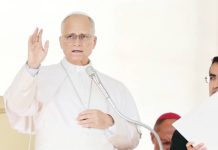
VATICAN – Pope Francis died of a cerebral stroke and irreversible heart failure, the Vatican’s top doctor said. Francis was 88.
The stroke led to a coma and “irreversible cardiocirculatory collapse”, Dr. Andrea Arcangeli, the head of the Vatican’s health department, said in a statement reported by multiple news outlets.
Francis died Monday at 7:35 a.m. at the Casa Santa Marta guesthouse at the Vatican where he lived.
In a statement, Arcangeli said Francis also suffered from episodes of respiratory insufficiency and had previously had bilateral pneumonia, as well as type 2 diabetes and hypertension.
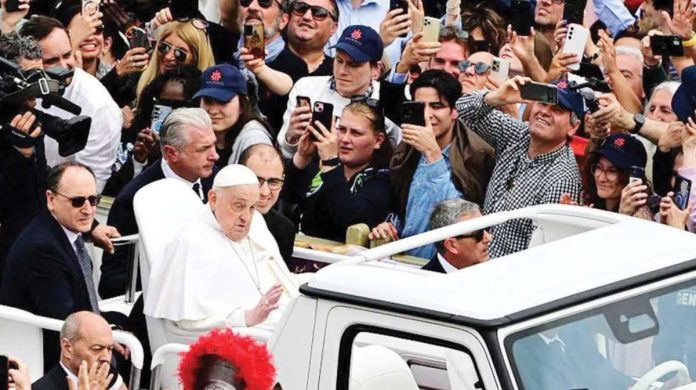
Francis recently spent more than a month in the hospital with double pneumonia. But he emerged from his convalescence on Easter Sunday to bless the thousands of people in St. Peter’s Square and make a surprise popemobile ride through the piazza.
It was his last public appearance before his death.
Pope Francis was the first Latin American leader of the Roman Catholic Church.
Services have been held around the world as some 1.4 billion Catholics begin to mark the Pope’s death. Meanwhile, mourners have started to arrive at the Vatican.
Francis, who was born in Buenos Aires, Argentina, was elected as Pope in 2013.
In a statement published by the Vatican early on Monday, Cardinal Kevin Farrell said the pope had “returned to the home of the Father”.
A statement continued: “He taught us to live the values of the Gospel with fidelity, courage and universal love, especially in favor of the poorest and most marginalized.”
Francis will lie in state in St. Peter’s Basilica, where mourners will be able to attend to pay their respects, before a funeral is held, which usually takes place within four to six days after a Pope dies.
The Pope requested that some elements of the elaborate death rites which usually take place after a pontiff’s death be dispensed with, including using an ornate coffin and displaying his body on a raised platform.
In his final testament, released by the Vatican late on Monday, he asked to be buried in Rome’s Basilica of St. Mary Major. Many of his predecessors instead chose St. Peter’s Basilica in the Vatican.
He wrote: “The tomb should be in the ground; simple, without particular ornamentation, bearing only the inscription: Franciscus.”
Francis’ death sets in motion the process of selecting a new Pope through an election known as a conclave, which typically takes place between 15 and 20 days after a Pope’s death.
The College of Cardinals – the Church’s most senior officials – will be summoned to Rome to take part in the secretive vote. In this case 135 cardinals – those aged under 80 – will be eligible to take part.
They will be shut in the Vatican until they reach an agreement, cut off from communicating with the outside world, in a process that can take days.
The outcome will set the direction of the Church, possibly for decades. The Pope appointed cardinals from a broader range of geographic and theological backgrounds than some of his successors, which could make the outcome of the process even more difficult to predict than usual.
Francis had endured bouts of ill-health in recent years, and was most recently discharged from Rome’s Gemelli Hospital on March 23 after being treated for pneumonia in both lungs.
The stay involved two “very critical episodes” which endangered his life, according to one of his doctors, and medics had advised a period of rest.
Francis continued to make some public appearances in his final weeks. Although the pontiff missed services on Good Friday and Holy Saturday, he did mark Holy Thursday with a traditional visit to Regina Coeli prison. However, he did not take part in the tradition of washing prisoner’s feet.
During his final public appearance on the balcony of St. Peter’s basilica on Easter Sunday, Francis spoke briefly but did not recite a full blessing, instead inviting an archbishop to do so on his behalf.
Even so, his appearance on a key day in the Catholic calendar was celebrated by worshipers.
In the hours after his death was confirmed, tributes poured in from around the globe. (BBC)