



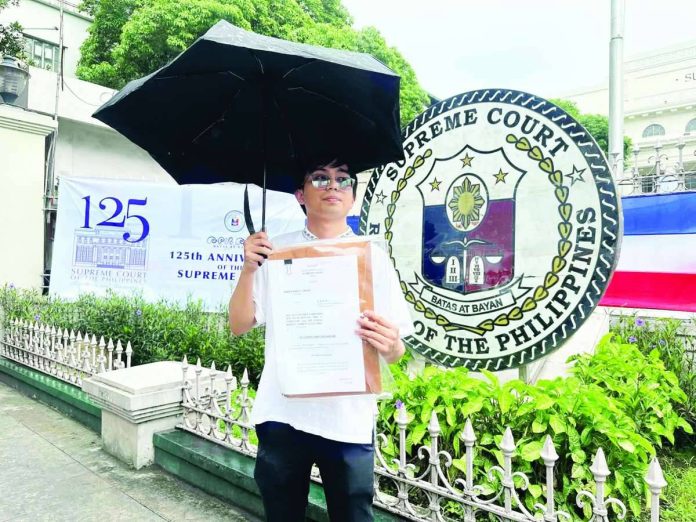
MANILA — The Supreme Court has dismissed a petition seeking to uphold the validity of the controversial June 3 Senate session that led to leadership changes and committee reorganization, ruling that the petitioner failed to establish legal standing to question the chamber’s quorum requirements.
In a decision released after Wednesday’s session, the high court rejected the petition filed by Las Piñas teacher John Barry T. Tayam, effectively leaving unresolved the constitutional dispute over whether the Senate had a valid quorum when it conducted proceedings that resulted in key leadership and committee changes.
Tayam had asked the Court to declare that the presence of 12 senators constituted a valid quorum during the June 3 session and to affirm the legality of actions taken during the proceedings, including leadership changes, declarations of vacancies, committee reorganizations, and other legislative measures.
However, the Supreme Court found that the petitioner failed to show that he had suffered a direct injury or faced an immediate threat of harm arising from the actions he sought to challenge.
According to the Court, “Tayam failed to show that he suffered, or was at imminent risk of suffering, any direct injury from the actions he challenged.”
The petition stemmed from a dispute within the Senate over the validity of the June 3 proceedings.
Senators Alan Peter Cayetano, Pia Cayetano, and Loren Legarda had argued that the session was invalid because only 12 senators were present, which they claimed fell short of the constitutionally required quorum of 13 members.
Despite the dispute, members of the minority bloc proceeded with the session after Senate President Francis “Chiz” Escudero attended the proceedings, resulting in what participants considered a 12-member quorum.
The session led to the election of Senator Sherwin Gatchalian as Senate President Pro Tempore and acting Senate president.
The reorganization also resulted in Senator Erwin Tulfo assuming the chairmanship of the Senate Committee on Accountability of Public Officers and Investigations, more commonly known as the Blue Ribbon Committee.
While dismissing the petition, the Supreme Court did not rule on the substantive constitutional issue of whether a 12-senator quorum was valid or whether the actions taken during the June 3 session were lawful.
Instead, the Court’s decision was anchored on procedural grounds, specifically the petitioner’s failure to establish the legal standing required to bring the case before the tribunal.
As a result, the controversy surrounding the Senate’s quorum requirements and the legitimacy of the June 3 proceedings remains unresolved./PN