



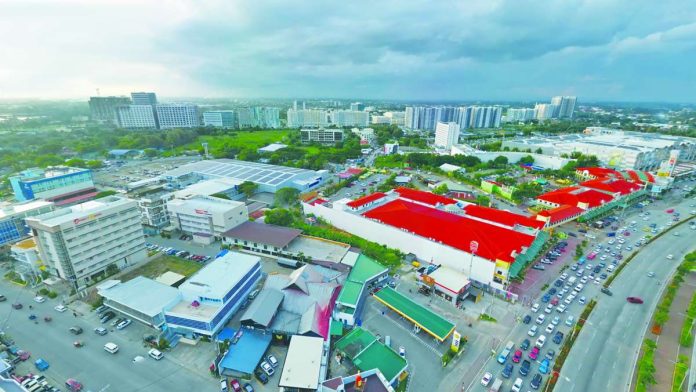
ILOILO City – This city faces a potentially dangerous convergence of sinking land and rising sea levels, with excessive extraction of groundwater threatening to accelerate land subsidence and expose communities to worsening floods, a marine science expert has warned.
Dr. Fernando Siringan, research professor at the Marine Science Institute, said continued dependence on groundwater, particularly deep wells, could cause affected areas to sink further even as climate change pushes sea levels higher.
“If we continue extracting groundwater, the land will continue to subside,” Siringan warned during the Science and Technology Forum on Navigating the Challenges of the New Normal in Iloilo City on Sept. 28.
The problem extends beyond Iloilo City, with measurable land subsidence also detected in neighboring municipalities.
A PSInSAR study covering 2014 to 2016, cited by Siringan, recorded the highest subsidence rate in Barangay San Rafael, Mandurriao district, at 8.8 millimeters per year, followed by Barangay Buntatala in Jaro district at 8.1 mm per year.
Subsidence was also recorded in Barangay Ungka I, Pavia, Iloilo at 4.7 mm per year; Barangay Alibay Norte, Oton, Iloilo at 4.6 mm; Barangay Calahunan, Mandurriao at 4.0 mm; and Leganes, Iloilo at 2.6 mm.
The findings underscore the potential long-term consequences for low-lying communities already vulnerable to flooding and sea-level rise, Siringan said.
Local governments should reassess their dependence on groundwater, especially deep wells, for domestic water requirements and move toward more sustainable surface water sources whenever possible, he stressed.
“We should not rely heavily on deep wells for our domestic water supply,” Siringan said.
He also proposed detention ponds as part of a broader water management strategy for Iloilo City and surrounding communities.
Detention ponds can temporarily store water that could be utilized during the dry season while reducing the amount of runoff entering drainage systems during heavy rainfall, helping ease flooding.
Siringan also called for measures to improve the land’s ability to absorb and retain water, including reforestation, terracing, hedges, and the planting of mixed native trees in upland areas and within the city.
Managing sedimentation is likewise crucial to prevent rivers and other waterways from becoming clogged or shallower, he said.
Siringan stressed that land subsidence should not be treated as an isolated environmental problem but as part of Iloilo’s broader challenge of managing its water resources amid climate change.
“If we fail to address this, we will face two problems — rising sea levels and sinking land,” he warned.
He also called for strict enforcement of easement regulations along rivers and other waterways to reduce the exposure of communities to flooding and other hazards.
Under Presidential Decree 1067 and Department of Environment and Natural Resources (DENR) Administrative Order 2021-07, easements of three meters in urban areas, 20 meters in agricultural areas and 40 meters in forest areas should be maintained from the high-water line of rivers.
Siringan said enforcing these regulations is necessary to protect the public, particularly communities increasingly exposed to changes in land and water conditions.
He stressed that land subsidence is no longer merely an environmental concern but a public safety and disaster-risk issue, especially as Iloilo confronts the combined pressures of groundwater extraction, flooding, climate change and rising sea levels./PN