

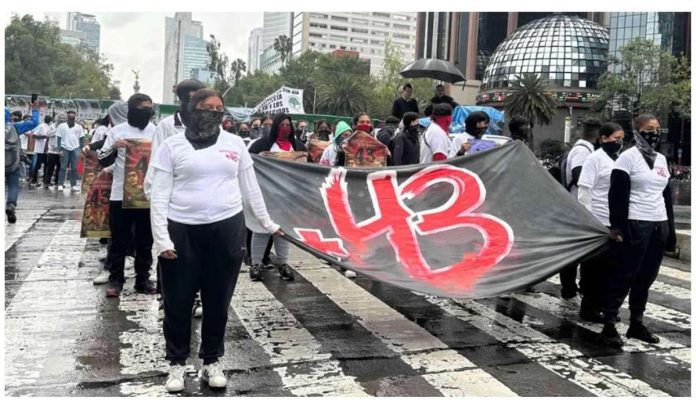
MEXICO City – Ten years ago 43 student-teachers travelling from the Ayotzinapa teacher training college, which has a strong history of activism, to an annual protest in Mexico City disappeared.
They went missing from the city of Iguala, and were last seen on security camera footage lying face-down on the back of police pick-up trucks as they were spirited out of the city.
The full story of the insidious relationship between the state and the cartels in Guerrero – and its part in the students’ abduction – has never been fully established.
In the intervening years, parents have been calling for the same thing. “Alive they took them, alive we want them back,” they chant.
In essence, it’s a call for the authorities to clarify exactly what happened to their children that night on 26 September 2014, to admit full culpability and to prosecute those involved.
An initial investigation, under then-President Enrique Peña Nieto, concluded that corrupt municipal police from Iguala and surrounding towns, acting on orders from the local mayor, handed the students over to the Guerreros Unidos drug cartel.
According to the investigation, the cartel killed the students and disposed of their remains, while federal police and military were deemed to be uninvolved.
However, this version – labelled “the historic truth” – was met with widespread skepticism. The Inter-American Commission on Human Rights (IACHR) challenged the findings, calling them “scientifically impossible”.
Further investigations have added new layers of complexity.
Journalist Anabel Hernández presented an alternative theory. She suggested that buses commandeered by the students to take them to Mexico City – a regular practice which was tolerated by the bus companies – were secretly transporting heroin.
Under her theory, the Mexican Army, acting on behalf of drug traffickers, intercepted the shipment, leading to the students’ deaths to eliminate any witnesses.
As a presidential candidate, Andres Manuel Lopez Obrador made repeated promises to leave no stone unturned in the case of the 43, and as president, he established a “truth commission” to reopen the case – promising to follow the evidence wherever it led.
Around a dozen soldiers were subsequently arrested as well as the former Attorney General Jesus Murillo Karam. However, almost all of those detained have since been subsequently released.
Furthermore, the independent investigators abruptly withdrew from Mexico last year citing a raft of issues with state authorities including a “lack of information”, “secrecy” and “hidden evidence”.
In February, the families of the missing students announced they would cease contact with the commission due to frustrations over the military’s lack of transparency. (BBC)