



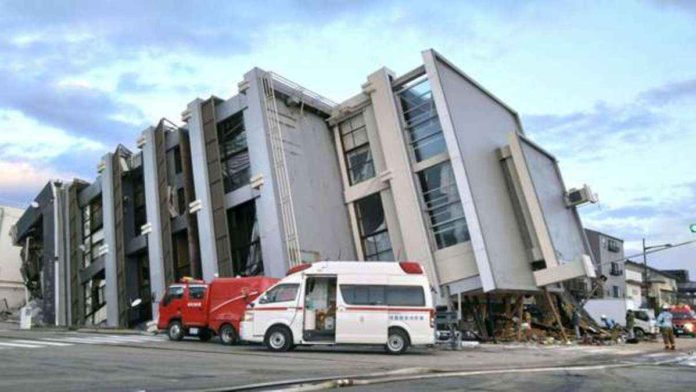
TOKYO – Six people have been killed in a powerful earthquake in Japan which caused homes to collapse and triggered tsunami warnings on Monday, Jan. 1, 2024.
Thousands of people living in coastal areas have spent the night in evacuation centers after being told to head to higher ground.
On Tuesday, there were no longer any tsunami warnings in place, with all downgraded to “advisories”.
The Japanese military has been handing out supplies including food, water and blankets for those who have had to leave home.
President Joe Biden says the United States stands ready to provide any necessary assistance.
According to national broadcaster NHK, all of the deaths are in Ishikawa prefecture, on the west coast of Honshu, Japan’s main island, which was the epicenter of Monday’s earthquake.
An unknown number of people are trapped under the rubble of dozens of buildings which collapsed in several towns.
Japan is very used to earthquakes on this scale, Dan Faulkner, a professor of geology and earth sciences at the University of Liverpool, tells BBC News.
“In this part of the world we kind of expect events of this kind of size and, in fact 60 years ago, about 200km [124 miles] to the north-east of where this event happened, there was a similar-sized earthquake back then too. So, it’s certainly not unknown to have earthquakes of this size in that particular area.”
He says Japan is so liable to earthquakes because it is part of the Pacific Rim of fire “where there’s lots of huge fault zones and subduction zones where tectonic plates are being thrust back down into the Earth’s mantle all the way around the Pacific.”
“And whilst this earthquake didn’t happen on one of those subduction zone faults, it’s all part of that same system where the tectonic plates are pushing against each other and this earthquake was a thrust fault earthquake where, basically, the Earth’s crust will have been pushed up by about 3.5 metres [11ft 6in] in this event.”
Faulkner says while the worst may be over, people can expect more tremors to come.
“Some of the aftershocks that Japan might experience are still going to be pretty large and they could affect infrastructure and buildings which are already weakened by the main event,” he says.
“But what we would expect scientifically, I think, in this region, is to see a gradual diminishing of earthquakes and we wouldn’t expect anything of a similar size. They should be less but still perhaps some pretty significant aftershocks still to come.” (BBC)