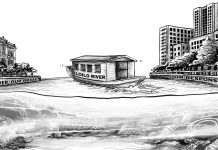




ILOILO traditional jeepney drivers continue to ply their routes from dawn until dusk as reported by this paper yesterday — not because the margins are good, but because stopping is simply not an option. For many of them, one missed day of work means unpaid rent, empty plates, or a child sent to school without allowance.
So they drive. And drive. And drive. Despite feeling being left to carry this burden alone.
As global fuel prices surge — fueled by geopolitical tensions thousands of miles away — local jeepney drivers are being squeezed dry by a system that has refused to adapt. Fares remain fixed. Fuel costs soar. Boundaries stay high. And government intervention? Barely felt.
Take the case of a veteran Iloilo driver who now spends as much as P1,800 a day on fuel, only to bring home around P400 — on a good day. Another driver in Barotac Nuevo town shares that after splitting earnings with the operator and paying for fuel, there is barely anything left. “Daw ginabuhi mo lang ‘ya gasoline companies,” he laments — it feels like you’re working just to keep fuel companies alive.
That is not livelihood. That is survival on borrowed time.
And yet, despite these realities, the state’s response has been tepid at best. Fuel subsidies — when they come — are often delayed, limited, or too small to offset the daily hemorrhage. Assistance programs exist on paper, but on the ground, drivers continue to shoulder the full weight of rising costs.
This is not just an economic issue. This is a policy failure.
Public transport is, by its very nature, a public service. It keeps cities moving, connects communities, and sustains local economies. But what we are seeing now is a dangerous shift — where the risks of this essential service are being privatized, dumped squarely on the shoulders of the most vulnerable: the drivers.
The state cannot continue to treat jeepney operations as if they are purely private ventures, immune from intervention. When global crises disrupt fuel supply chains, when prices spike beyond the control of ordinary workers, it is the government’s responsibility to step in — not as a spectator, but as a stabilizer.
Where are the sustained fuel subsidies that reflect real-world costs? Delayed.
Where is the targeted financial aid that reaches drivers before their pockets run dry? Delayed, if not non-existent.
Where is the tax relief that could at least cushion the blow of rising fuel prices?
More importantly, where is the sense of urgency? Because on the ground, urgency is all that drivers know. They feel it every time they count their earnings at the end of the day and realize most of it has gone straight into the fuel tank. They feel it when they hand over boundary payments that no longer make economic sense. They feel it when they look at their children and wonder how far P200 — or less — can stretch.
And yet, they keep going. “Kayod lang,” as one driver said. Just keep grinding.
But for how long?
Resilience has become the most overused — and most abused — word in times like these. It is easy to praise the endurance of jeepney drivers, to romanticize their grit and sacrifice. But resilience should not be an excuse for government inaction. It should not be a substitute for policy. Because what we are witnessing is not resilience — it is systemic neglect dressed up as endurance.
If the government continues to delay decisive intervention, the consequences will not stop with the drivers. A weakened jeepney sector means disrupted mobility, higher transport costs, and a ripple effect across local economies. In short, this is not just their crisis — it is everyone’s.
The jeepney engines are still running, yes. But without meaningful intervention, it is only a matter of time before the system itself breaks down.