



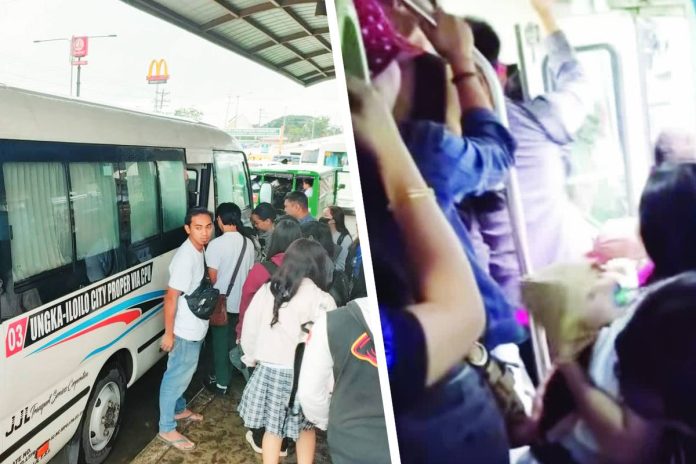
ILOILO City — Persistent overloading in public jeepneys and minibuses is a direct result of government policy failures and a shrinking transport fleet — not commuter indiscipline — the Panay Consumers Alliance (PCA) declared, as it challenged authorities to address what it described as a worsening public transport crisis in Iloilo City and Province.
In a statement, the group said overcrowded vehicles are the “predictable outcome” of flawed transport planning under the national government’s Public Utility Vehicle Modernization Program and the Iloilo City Government’s Local Public Transport Route Plan (LPTRP), which it claimed significantly reduced passenger-carrying capacity without ensuring adequate replacements.
Social media users recently circulated a video showing an overloaded modernized bus, with passengers claiming they were asked to get off so others could board — a scene that reignited public outrage over commuter safety.
“Overloading is not the fault of commuters, conductors, passenger assistance officers, or drivers,” said PCA convenor Irma Espinosa. “It is the direct result of poor and unscientific government transport planning and the absence of a comprehensive public transport system.”
Citing local transport data, the PCA said public transport vehicles comprise only 20% of all vehicles on Iloilo roads but serve 74% of commuters. Of these commuters, 41% travel for work, 20% for school, and 39% for errands and other personal purposes. About half come from the province, while the other half travel within the city.
Before modernization, according to PCA, around 2,587 jeepneys operated in Iloilo City, each carrying about 20 passengers per trip and making 10 to 12 trips daily — equivalent to roughly 200 to 240 passengers per unit per day.
The old system could move an estimated 517,400 to 620,880 passengers daily, said Espinosa.
After the implementation of the LPTRP, only 1,262 franchised units and 556 QR-coded units remained, effectively removing at least 769 jeepneys and cutting an estimated 153,800 to 184,560 passenger trips daily, she said.
Although 537 modern buses were introduced, only about 70% to 80% — or roughly 376 to 430 buses — operate daily, PCA claimes.
While each bus carries about 34 passengers per trip, it averages only eight to 10 trips a day, transporting 272 to 340 passengers per unit daily, it added.
“At this rate, the operational bus fleet can transport only about 102,272 to 146,200 passengers daily — far below the capacity lost when jeepneys were removed,” said Samantha Faye Herbolario, PCA convenor for students and commuters. “This shortfall clearly explains why overloading persists.”
The PCA also pointed to successive transport policies, including the 2013 perimeter boundary ordinance and recent restrictions on first-town jeepneys, which limit where provincial units can load and unload passengers, forcing commuters to take multiple rides instead of a single trip and increasing travel time, inconvenience, and expenses.
The group criticized proposals to form a task force to monitor overloading, calling the measure “insufficient and misguided.”
“Enforcement alone cannot solve a shortage problem,” Espinosa said. She added: “Penalizing drivers or superficially augmenting passenger capacity without increasing the number of vehicles fails to address the systemic shortage.”
Public transportation is a public service, not merely a profit-driven enterprise, PCA pointed out.
“If the government is serious about commuter safety and dignity, it must increase the number of units, restore viable routes, support small operators and drivers, and develop a genuinely people-centered mass transport system,” said Espinosa.
The PCA warned that overloading will continue as long as these policy failures remain unaddressed. (RJM/PN)