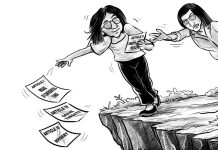




AS THE conflict involving Iran, Israel and allied actors escalates, the world watches missiles and borders. Yet in Lebanon and the occupied West Bank, another system is under growing strain. It is the unpaid care and survival work that keeps households functioning when services, infrastructure and livelihoods fail. This work is less visible than battles, but humanitarian agencies recognize it as essential. Women and girls carry most of this burden.
In homes, shelters and displaced communities, the effects of conflict go beyond broken roads, unreliable electricity, or collapsed services. Layla’s story shows the reality many women face. She wakes before sunrise to collect water because her municipal supply has not arrived in weeks. Her mother’s medicine is running out. The electricity may not last long enough to cook a meal. Each day is filled with difficult choices and those choices keep families alive when public systems fail.
When schools close, clinics are hard to reach and water or electricity is scarce, women are often left to manage daily life. Kitchens become classrooms, pharmacies, offices and care centers all at once. Women stretch food and medicine, supervise children who cannot attend school, tend to sick relatives and maintain the household through constant uncertainty. Their work holds families and communities together, yet it is rarely recognized, rarely paid and often treated as if it is simply part of being a woman.
This burden is what I call “care debt.” It is the unpaid labor that sustains society’s social fabric but comes at the cost of women’s economic and personal freedom. Care debt prevents societal collapse, yet it is invisible in economic statistics and often ignored in policies that could support these workers.
In Lebanon, years of economic collapse and weak public services have left families struggling with systems that fail to meet basic needs. Clinics are crowded, classrooms disrupted and homes often lack steady power or clean water. The burden moves inside households and women are expected to carry it. They care for the sick, help children keep up with school, make food and medicine last longer and manage shortages. Their labor sustains society, yet it goes unnoticed and uncompensated.
Women in these societies are not merely surviving. They are holding everything together, but this comes at a cost. Unpaid labor keeps the economy from collapsing while pushing women further into poverty. Their work is essential, yet it is often treated as disposable and invisible. Care debt is measured not only in hours of labor but also in missed opportunities for education, employment and personal advancement.
This is not a problem confined to Lebanon or the West Bank. Across conflict zones worldwide, women bear the brunt of societal breakdown, yet their contributions remain undervalued. Economies that fail to account for unpaid care work create profound injustices that demand attention.
Addressing care debt requires more than economic recognition. It touches on fundamental justice. Societies must challenge the inequalities that allow women’s labor to go unrecognized. Policies should support caregivers, provide financial relief for unpaid work, offer healthcare and ensure infrastructure that sustains daily life is reliable.
International donors and organizations must understand that reconstruction cannot succeed without addressing the gendered economic structures that make women’s labor invisible. True rebuilding requires acknowledging the people who keep communities alive every day.
We must also change how care work is valued. Crisis has conditioned us to see care as automatic, labor that women are expected to provide for free. This assumption is unsustainable. As the world focuses on geopolitics, we must also see the hidden workforce sustaining societies and ensure they receive recognition, compensation and support.
Women are carrying the “care debt” not just in the Middle East but in conflict zones around the world. Ignoring this debt perpetuates an unjust system, leaving the most vulnerable to bear the heaviest burdens. The cost is not only personal; it affects the future of entire communities. Recognizing and valuing women’s labor is essential if societies hope to be just, stable, and resilient.
***
Columnist Bio
Nicasio A. Pimentel III is a UK-certified human resources practitioner and educator with over 16 years of experience spanning HR strategy, analytics, systems integration and talent management across several Fortune Global 500 companies and public sector institutions in UK, Australia, the Middle East and the Philippines. He holds an MSc in Management and Human Resources from the prestigious London School of Economics and a BA Psychology from the University of the Philippines Diliman. He teaches psychology at the University of Antique. For questions, e-mail nicasio.pimentel@antiquespride.edu.ph./PN