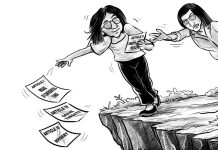



YOU KNOW politics is in trouble when it starts performing instead of working. Gestures get louder, statements sharper, and moments carefully staged.
There are villains and heroes, urgency everywhere—and still, nothing really moves. We have lived through this pattern for decades, now repackaged with slicker visuals, fiercer click baits, and younger faces.
UP political scientist Jean Encinas-Franco recently captured this shared feeling. In her remarks on Leandro Leviste’s public behavior, she pointed away from labels and age, and toward something more basic—the absence of consistent work that signals real conviction.
What comes through instead is staging. Statements designed to circulate. Gestures meant to provoke reaction. A politics that looks busy, but leaves little behind once the cameras move on.
Strip away the novelty and the pattern feels familiar. Say the most headline-friendly line. Hint at a revelation without following through. Frame yourself as the lone brave voice against a vague but powerful enemy. Keep the audience watching.
This is not disruption. It is an old political script with updated packaging. Voters have seen it before from seasoned trapos (traditional politicians) and self-styled outsiders alike. The difference now is speed. What once took weeks of press coverage now happens in a single viral cycle.
The danger of performative politics is not that it is noisy. The danger is that it feeds on emotion while starving institutions. Governance, at its core, is slow, technical, and often unglamorous. It lives in committee hearings that nobody streams, budget lines that never trend, and implementation details that rarely inspire applause.
Serious public servants are boring in public because their real work happens elsewhere. They speak in specifics: bills filed, budgets defended, programs revised, metrics tracked. Performance politics replaces that discipline with spectacle.
This is why Encinas-Franco’s critique resonates. It is not personal, and it is not moralistic. It is diagnostic. When statements outpace evidence, when exposure replaces accountability, and when moral certainty arrives ahead of due process, skepticism is not cynicism. It is civic literacy. We are right to ask not only what is being said, but what follows after the post is shared and the rally disperses.
Social media has sharpened this problem. Attention is now the most valuable currency in politics, and platforms reward immediacy over depth. A carefully edited confrontation travels farther than a drafted bill. A viral sound bite outperforms a budget hearing. As media scholar Jonathan Ong has noted elsewhere, modern political visibility often relies on repetition, emotional hooks, and simplified narratives. Performativity becomes the proof of relevance. If it looks like leadership, it must be leadership.
This is why performative politics works, especially among younger voters raised on screens and feeds. For a generation tired of recycled promises, a fresh tone can feel like progress. The politician who shows up, responds quickly, and appears constantly engaged can feel more authentic than one buried in process. The problem is that authenticity without outcomes is still empty. Presence does not equal progress. Visibility does not repair systems. (To be continued)/PN