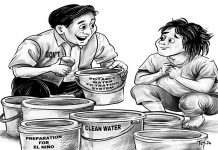




IN ILOILO Province today, the quality of the water you drink depends largely on where you live. That should trouble us all.
Recent data from the provincial government show that only 11 out of 43 local government units in Iloilo meet the national standard for safely managed drinking water. These include relatively better-resourced areas such as Pavia, Santa Barbara, and Passi City. The rest — more than three-fourths of Iloilo’s LGUs — fall short of the basic benchmark that water should be accessible, available for extended hours, and free from contamination.
Behind these numbers lies a stark inequality: some Ilonggos turn on a tap and receive safe, treated water within their homes, while others must rely on wells, springs, and communal sources whose safety is uncertain and whose supply is often unreliable. In many rural and underserved communities, water is not only harder to access — it is riskier to consume.
According to the Provincial Government Environment and Natural Resources Office itself, nearly 59 percent of households in Iloilo depend on Level I sources such as wells and springs. Only about 28 percent enjoy individual household connections. That gap reflects uneven development, uneven investment, and ultimately, uneven protection of public health.
Safe water is not a privilege reserved for those in urban centers or economically advantaged municipalities. It is a fundamental right. And when access to that right varies so widely across a single province, it becomes a social justice issue.
The consequences are real and immediate. Communities without safely managed water face higher risks of water-borne diseases. Families must spend more time and resources securing water that should be readily available. Children grow up in environments where something as basic as drinking a glass of water carries uncertainty.
What makes this inequality more troubling is that it persists despite clear standards and known solutions. The Department of Health has set measurable targets. The definitions of safe water are established by global institutions. The risks of non-compliance are well understood. Yet the divide remains — and in some cases, is widening.
Local governments often point to limited budgets as the primary constraint, particularly in conducting regular water quality testing. This is a valid concern. But when financial limitations consistently prevent compliance with something as essential as water safety, it signals a deeper problem in how priorities are set and resources are allocated.
It also raises a necessary question: why are some LGUs able to meet the standard while others cannot?
Is it a matter of capacity? Leadership? Access to funding? Or a combination of all three?
Whatever the answer, the result is the same — an uneven landscape where geography determines safety.
The provincial government’s Integrated Water Security Plan offers a long-term framework to address these challenges. It envisions 24/7 access, sufficient supply, and potable water for all by 2035. It is a step in the right direction. But plans alone will not close the gap unless they are backed by immediate, targeted action that prioritizes the most underserved communities.
Equity must be at the center of any solution. This means directing resources where the need is greatest, not where implementation is easiest. It means ensuring that rural municipalities are not left behind in infrastructure upgrades. It means strengthening support for regular water testing in LGUs that lack the means. And it means holding all levels of government accountable for delivering on the promise of safe water for every Ilonggo.
Water inequality is not inevitable. It is the result of decisions—about funding, planning, and prioritization. And it can be corrected with the same deliberate effort.
In a province striving for inclusive growth, no one should be left behind at the most basic level of all: the water they drink.