


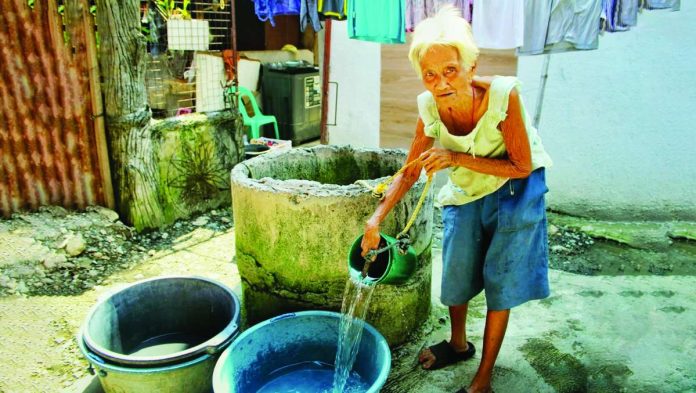
ILOILO City — Several shallow wells in Iloilo City have been recommended for condemnation after laboratory tests found their water remained contaminated despite chlorination, raising serious public health concerns as authorities prepare for a possible six-month El Niño that could drive more households to depend on underground water sources.
The findings have prompted the city government to intensify its inventory and monitoring of shallow wells across 25 barangays considered vulnerable to prolonged dry conditions, with particular attention to communal wells serving multiple families.
General Services Office (GSO) head and Crisis Management Council logistics-in-charge Engr. Neil Ravena disclosed that previous water quality assessments conducted with the City Health Office and City Environment and Natural Resources Office identified wells that remained unsafe despite disinfection efforts.
“We chlorinated the wells and conducted water testing, but the samples still failed laboratory examinations. Once we received the results, we immediately recommended that the affected wells be condemned,” Ravena said.
The disclosure highlights the potential health risks confronting households that depend on shallow wells, especially in densely populated communities where water sources may be situated dangerously close to septic tanks.
Ravena warned that contamination in communal wells could expose numerous families to unsafe water because several households often share a single source.
“We need to be very careful with communal wells because many families use them. We also have to ensure that these wells are not located near household septic tanks, which could create serious health problems,” he stressed.
The proximity of wells to household sanitation facilities is a particular concern because contaminants can seep into underground water sources, potentially making the water unsafe for drinking and other domestic uses.
25 barangays under watch
The city government is consolidating an inventory of shallow wells to determine which are privately used and which serve multiple households.
The initiative forms part of preparations for a possible El Niño episode from October 2026 to March 2027, which could reduce water availability and increase dependence on alternative sources.
“The inventory is still ongoing. I have directed the separation of wells used by the public from those used exclusively by individual families so we can properly organize the data,” Ravena said.
The inventory will allow authorities to identify wells requiring closer monitoring, additional laboratory examinations and possible intervention to protect residents from contaminated water.
Ravena said barangay officials are coordinating with the city government to monitor water conditions, particularly in communities where prolonged dry weather could affect household supplies.
Although authorities have identified 25 vulnerable barangays, Ravena said existing monitoring has not indicated a critical shortage of water from shallow wells.
“So far, our water supply has not reached a critical level because it rains almost every afternoon. Based on our monitoring, no problems with shallow wells have been reported,” he said.
“However, we are looking at both the quantity of water being extracted from these wells and its quality to ensure that the water is not contaminated,” he added.
The monitoring seeks to ensure that households have access not only to sufficient water but also to supplies that are safe for consumption.
Excessive extraction raises another threat
Apart from contamination, Ravena raised concerns that increased reliance on groundwater during prolonged dry conditions could aggravate land subsidence in Iloilo City.
Land subsidence refers to the gradual sinking of the ground, a phenomenon that can threaten infrastructure and worsen flood vulnerability.
Ravena cautioned that excessive groundwater extraction could create additional environmental problems if households and communities increasingly turn to underground sources to compensate for reduced water availability.
“Iloilo City is prone to land subsidence. If we extract too much groundwater, we could create another problem,” he warned.
He urged authorities to consider available surface water sources before resorting to additional groundwater extraction, particularly during periods of extreme heat and reduced rainfall.
“I am advocating that we consider other available water sources first and prioritize surface water. Groundwater extraction should be considered only when necessary, particularly in a worst-case scenario,” Ravena said.
While excessive groundwater withdrawal can contribute to land subsidence, determining its actual impact in specific areas of Iloilo City would require scientific assessment.
The city government hopes the ongoing well inventory, water quality testing and coordination with barangay officials will help identify potentially unsafe water sources and prevent excessive extraction.
With the possible El Niño threatening to put additional pressure on existing water supplies, authorities face the challenge of ensuring that households have sufficient water without exposing residents to contamination or creating longer-term environmental risks./PN