



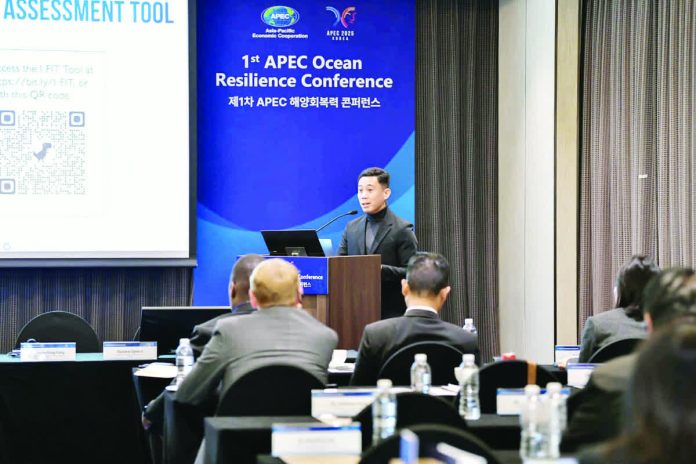
ILOILO City – The Philippines placed the escalating threat of illegal, unreported, and unregulated (IUU) fishing front and center on the global stage as the Bureau of Fisheries and Aquatic Resources (BFAR) in Western Visayas represented the country in the first-ever APEC Ocean Resilience Conference held on Nov. 20 and 21 in Busan, South Korea.
In a gathering aimed at forging stronger Asia-Pacific cooperation amid worsening ocean degradation, BFAR Region 6 official Joel Abalayan warned APEC economies that IUU fishing continues to inflict massive economic and ecological damage on the Philippines, stressing that the issue weakens both marine sustainability and fisheries governance.
Presenting the country’s latest data, Abalayan cited the 2021 I-FIT Assessment, which estimated annual IUU fishing losses at 113,000 metric tons, translating to US$95 million in economic damage.
“IUU fishing not only diminishes stock levels but also undermines governance systems, creates an uneven playing field among fishers, and hampers the overall sustainability of marine resources,” he said.
APEC economies confront ocean threats
Hosted by the Republic of Korea’s Ministry of Oceans and Fisheries, the inaugural APEC conference convened policymakers, scientists, and fisheries experts to confront mounting challenges, including sea-level rise, intensifying natural disasters, and declining marine biodiversity.
Delegates discussed disaster risk management, the integration of marine climate data, and technological innovations to strengthen the region’s capacity to respond to climate-driven ocean changes such as rising temperatures, acidification, and habitat loss.
Workshops showcased successful case studies where data-driven and cross-border collaboration led to improvements in fisheries resilience and marine resource protection.
Roadmap for 2026–2030 adopted
The conference ended with the adoption of the APEC Ocean Resilience Enhancement Roadmap 2026–2030, a strategic guide for building science-based, regionally coordinated approaches to safeguarding ocean health and supporting coastal communities.
For the Philippines — an archipelagic nation heavily dependent on marine resources — the roadmap reinforces its push for stricter action against IUU fishing and greater cooperation with APEC economies.
By elevating the urgency of IUU challenges and participating in the drafting of long-term resilience strategies, BFAR-6 said the country aims to “protect its rich marine biodiversity and ensure the long-term viability of ocean resources for future generations.”/PN