


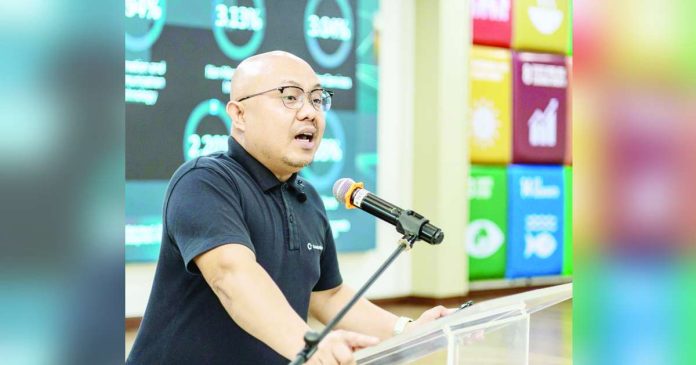
ILOILO City — Government work is built on mandates, public accountability, and real operating limits. For Ken Lerona, effective collaboration starts with institutional respect and practical design.
“Government work succeeds when it is designed around mandates and accountability,” he says. “Our job is to strengthen delivery within the agency’s structure, language, and decision pathways.”
Lerona is the Principal Consultant, Founder & President of Cornelius Magnate Engagement & Consulting, an Iloilo-based training and consulting firm that has supported programs and initiatives with the Department of Trade and Industry (DTI), Department of Agriculture (DA), DA–Philippine Rural Development Program (PRDP), DTI–Philippine Trade Training Center Global MSME Academy, Department of Social Welfare and Development (DSWD), Department of Science and Technology (DOST), the Board of Investments, and local government units across the Philippines.
Q: What is different when working with the government compared to corporate organizations?
Lerona: Government teams carry a different form of responsibility. Decisions are tied to mandates, budget rules, audit requirements, and service obligations. When a program respects those realities, it becomes easier to sustain and defend.
Q: You often talk about an “architecture mindset.” What does that mean when working with government?
Lerona: Architecture means seeing the whole system and how parts depend on each other. We look at roles, sequencing, hand-offs, and decision routes across offices and partners. Then we work with stakeholders to improve coordination within the bounds of structure and policy, so delivery becomes smoother without creating confusion or risk.
Q: How do you approach projects with agencies that already have established structures?
Lerona: We start by understanding the mandate and the operating constraints. We look at reporting lines, program cycles, and internal performance measurement. Our solutions are tailored to the needs of a particular government agency or its stakeholders, designed around their realities so the work fits and adoption holds.
Q: Can you share an example where this approach was applied?
Lerona: A case in point is our engagement with the Board of Investments in the Visayas. We designed an Investment Promotion Roadmap Architecture Lecture for local economic development and investment promotion officers from Western, Central, and Eastern Visayas. The session treated investment promotion as an operating system with clear roles, sequencing, and shared routines across BOI, DTI, LGUs, and ecosystem actors. We worked through investor psychology, readiness signals LGUs can operationalize, facilitation as a journey with seamless hand-offs, SIPP and CREATE MORE alignment, and the discipline of focus when defining a local investment proposition.
Q: How does your work support livelihood and enterprise development?
Lerona: Through the DTI–PTTC Global MSME Academy, we delivered a tailored program for DTI–CARP Agrarian Reform Beneficiaries to help them start and strengthen their MSMEs. We taught hyperlocalized Integrated Marketing Communication, grounded in the realities of where they sell, who they serve, and how their local markets behave. Participants came from Luzon, Visayas, and Mindanao, so we designed the learning to respect regional differences while keeping the core discipline intact.
Q: You have also worked with social development agencies. What did that look like?
Lerona: For DSWD Region VI, we delivered a workshop on Systems Thinking. Many government programs involve multiple offices and partners. Systems thinking helps teams map dependencies, spot bottlenecks early, and improve coordination without adding unnecessary layers.
Q: You’ve also worked with farmer groups under DA-PRDP. How did you tailor those interventions?
Lerona: Under the DA–Philippine Rural Development Program, we ran innovation programs for Farmer Cooperatives and Associations as part of capacity development. We also introduced Pamamahalang Pilipino, designed for the sector’s lived realities and grounded in Filipino values. The work focused on leadership, collaboration, and governance habits that strengthen implementation on the ground.
Q: You recently spoke at DEPDev Region VI about “pedestrianizing AI.” How does AI fit into your government systems work?
Lerona: I treat AI the same way I treat any government reform lever: it has to be operational, accountable, and accessible. In my DOST AI Fest talk, I made a related point: AI adoption is both a technical and cultural challenge, and communication becomes the bridge between innovation and ethical use. If we pedestrianize AI, we bring it down to street level so it supports service delivery and protects trust. That means designing AI use around real workflows, improving literacy so people can use tools responsibly, and building feedback loops so communities can flag risks early.
Q: What is the broader goal behind your government work?
Lerona: It’s to strengthen institutions so they can serve people better. When systems improve, service delivery becomes more reliable, and trust strengthens over time.
About Cornelius Magnate Engagement & Consulting
Cornelius Magnate Engagement & Consulting is a bespoke strategy and advisory firm specializing in training, innovation, and reputational risk management. Its founder, Ken Lerona, is a marketing, innovation, and communication leader with over 20 years of cross-industry experience and a Master in Innovation and Business (MIB) from the Asian Institute of Management.
Know more about us at corneliusmagnate.com./PN