


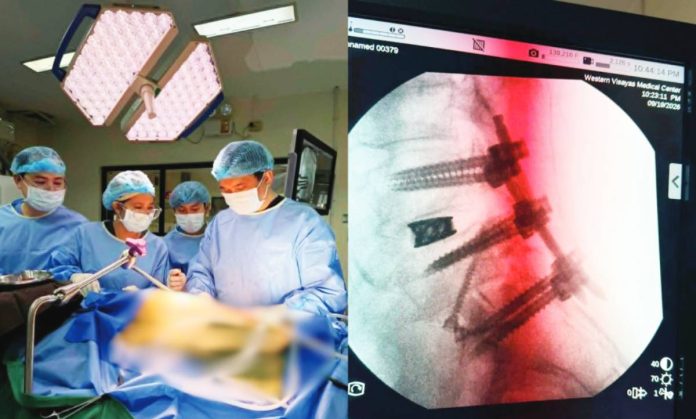
ILOILO City – Patients suffering from complex spinal disorders may no longer need to seek highly specialized surgical treatment outside Western Visayas after the Western Visayas Medical Center (WVMC) successfully performed the region’s first combined advanced spine surgery, marking a major breakthrough in local neurosurgical care.
The landmark procedure, performed on September 19, 2026, involved the use of eXtreme Anterior Lumbar Interbody Fusion (XALIF) at the L5–S1 level and an Anterior-to-Psoas (ATP) approach at the L4–L5 level, two advanced surgical techniques designed to treat spinal instability and nerve compression while minimizing damage to surrounding tissues.
Neurosurgeon and spine surgeon Dr. Derek Ben T. Jabines led the pioneering operation alongside WVMC’s Neurosurgery Spine team through the hospital’s Brain and Spine Center.
The patient, a 63-year-old man, had been suffering from degenerative spine disease affecting the lower lumbar and sacral regions, a condition that can cause persistent back pain, nerve compression and difficulty performing everyday activities.
Degenerative spine disease occurs when the discs, joints and other structures supporting the spine gradually deteriorate, potentially causing instability and pressure on surrounding nerves.
Patients with advanced cases may experience chronic lower back pain, numbness, weakness and shooting pain extending into the legs, significantly affecting mobility and quality of life.
Unlike conventional open spinal surgery, which often requires extensive dissection of back muscles, the combined XALIF and ATP techniques allow surgeons to reach affected spinal structures through alternative pathways.
The XALIF procedure provides access to the junction between the lowest lumbar vertebra and the sacrum through the front of the body, allowing surgeons to prepare the damaged disc space and stabilize the spine without extensively disturbing the back muscles.
Meanwhile, the ATP technique approaches the L4–L5 spinal segment from the side, navigating around the psoas muscle to minimize disruption to surrounding tissues and reduce the risk of nerve injury.
“These techniques allow surgeons to access the spine from the front or side of the body rather than relying solely on a traditional approach from the back,” WVMC stated.
By combining the two approaches, the surgical team was able to address spinal alignment, stabilization and nerve decompression while limiting disruption to healthy tissues.
The techniques offer an alternative to more invasive conventional procedures, which may involve greater postoperative discomfort and longer recovery periods.
Beyond the successful operation, the medical breakthrough represents a significant advancement in the availability of specialized healthcare services in Western Visayas.
Complex spinal procedures of this nature were previously associated with major medical centers outside the region, often requiring patients to travel considerable distances to obtain specialized treatment.
The successful surgery demonstrates WVMC’s growing capability to perform highly technical neurosurgical procedures locally, potentially reducing the need for patients to seek comparable treatment in other parts of the country.
“Advancing expertise. Expanding access. Bringing specialized spine care closer to home,” WVMC stated.
The hospital commended Jabines and the entire Neurosurgery Spine team for their surgical expertise, teamwork and commitment to improving patient care.
WVMC also emphasized that the patient’s identity and medical information were handled in accordance with confidentiality and privacy requirements.
The achievement further strengthens WVMC’s position as a regional referral center for specialized medical services and highlights the growing capacity of public healthcare institutions in Western Visayas to deliver advanced surgical interventions previously associated with larger metropolitan hospitals./PN