



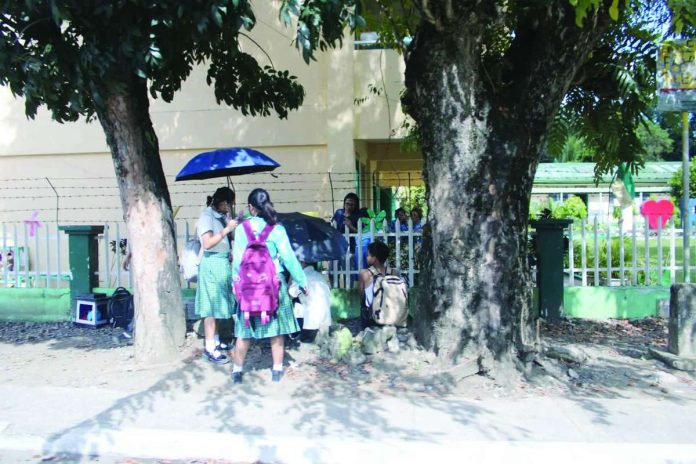
ILOILO City – A dangerous heat index reaching 43 degrees Celsius has disrupted the education of 113,022 students across 122 public schools in Western Visayas, forcing widespread class suspensions and a complete halt to academic requirements as authorities warn of worsening extreme heat amid an intensifying El Niño phenomenon.
The Department of Education (DepEd) Region 6 reported Tuesday, November 3, that the emergency suspensions affected three schools division offices, with Iloilo City accounting for the largest number of affected learners.
Official figures showed that 73,127 students from 65 schools in Iloilo City were affected, followed by Roxas City with 31,685 students from 50 schools and Capiz province with 8,210 students from seven schools.
The suspensions followed heat index readings of 43°C in Iloilo City, 42°C in Roxas City and 40°C in Mambusao, Capiz.
Highest heat alert activated
The suspensions followed DepEd Memorandum No. 064, series of 2026, signed by Education Secretary Sonny Angara, establishing a four-tier heat response framework for schools.
Under the framework, a heat index of 42°C or higher activates Level 4, known as “Hinto”, requiring the suspension of both face-to-face classes and modular or asynchronous academic requirements.
Unlike lower alert levels that allow learning activities to continue through alternative arrangements, the highest classification provides students and teachers relief from academic obligations during dangerous heat conditions.
DepEd Region 6 information officer Hernani Escullar Jr. confirmed that the guidelines had been distributed to schools throughout Western Visayas.
“The safety, well-being, and health of our learners and personnel are of utmost priority as of the moment,” Escullar stressed.
The framework also establishes three lower classifications: “Hayo” for readings below 27°C, allowing regular classes with hydration breaks; “Hinay”, from 27°C to 32°C, permitting schedule adjustments and flexible learning; and “Hinga”, from 33°C to 41°C, requiring the suspension of face-to-face instruction in favor of alternative learning arrangements.
Outside Iloilo City, Pavia National High School and Pavia Pilot Elementary School, Pavia, Iloilo also suspended in-person classes, while Abilay Elementary School and Cambitu Elementary School in Oton, Iloilo canceled afternoon classes.
Beyond the public schools covered by DepEd’s figures, major universities and private educational institutions implemented separate emergency measures.
Universities shift learning arrangements
Major universities implemented varying restrictions on classroom activities, with some retaining essential laboratory work and professional courses.
West Visayas State University (WVSU) Main Campus in La Paz, Iloilo City declared Code Orange under its emergency alert system, automatically suspending physical classes on November 3 and shifting to mediated learning.
Exemptions covered the Colleges of Law, Medicine and Dentistry, as well as courses requiring Related Learning Experiences. Satellite campuses experiencing similar heat conditions were directed to act at the discretion of their administrators.
Iloilo Science and Technology University (ISAT U) Iloilo City Campus shifted junior high school classes and college lectures to synchronous or asynchronous online instruction while allowing scheduled laboratory classes to continue.
Faculty handling lectures were authorized to work remotely, although administrative operations remained active.
The University of the Philippines Visayas Iloilo City Campus likewise moved lecture classes to remote learning, while essential laboratory activities and scheduled examinations could proceed under strict safety precautions.
Central Philippine University (CPU) activated its Learning Continuity Plan, transferring preschool to senior high school students to asynchronous online learning. Its Colleges of Law and Medicine were placed under separate directives.
The University of San Agustin suspended face-to-face classes and physically demanding activities on November 3 and 4, including outdoor sports, fieldwork and laboratory activities involving excessive heat exposure.
These university-level arrangements were separate from DepEd’s mandatory highest-level heat response for public basic education schools.
Angelicum School of Iloilo (which offers pre-elementary, elementary and secondary level education) also suspended in-person classes.
PAGASA warns of worsening heat
Philippine Atmospheric Geophysical and Astronomical Services Administration (PAGASA) Iloilo weather facilities technician Jeff Patrick Maquiling warned that the heat index could rise further in the coming months as El Niño strengthens and rainfall declines.
“Ang health risk naman dira is ang heat cramps and heat exhaustion are likely gid and ang heat stroke is probable with continuous exposure under the heat,” Maquiling told Panay News.
The danger category covers heat index readings from 41°C to 51°C, while readings of 52°C and above fall under extreme danger.
At noon on November 3, PAGASA recorded a heat index of 41°C, indicating that hazardous heat conditions persisted.
Maquiling said the agency resumed daily heat index monitoring on November 1, with operations likely to continue into the hot and dry season of 2027.
“Nagsugod kita sang November 1 sa pag-monitor sang heat index and continuous na ina until nga maghambal ang Central Office namon nga mag-untat pero most likely until na sia sa hot and dry season naton next year,” he said.
During the 2024 El Niño episode, Iloilo recorded a peak heat index of 46°C in May, following consecutive days of readings between 44°C and 45°C.
Maquiling said the previous El Niño was classified as weak, while the current episode is forecast to potentially become very strong.
“Bali may ara gid possibility nga makabatyag sang mas mataas pa gid nga heat index sa mga masunod nga binulan since during last time amo ina, kon sa diin mas nami ang tiempo naton, mas wala sang ulan, and mas gamay gawa ang aton clouds. So, from that alone, we will be experiencing much more higher temperatures which translates to high heat index,” he warned.
However, PAGASA could not determine whether the heat index would reach 50°C during the March-to-May 2027 period, citing variations in temperature and environmental conditions.
Dry spell threatens to worsen
Compounding the extreme heat, PAGASA confirmed that Iloilo province has entered a dry spell, with conditions potentially deteriorating into drought in the coming months.
Maquiling said a dry spell occurs after three consecutive months of below-normal rainfall, representing a 21 percent to 60 percent reduction, or two consecutive months of rainfall deficits exceeding 60 percent.
Drought develops after three consecutive months of rainfall deficits exceeding 60 percent or five consecutive months of below-normal rainfall.
PAGASA earlier projected drought conditions in Capiz beginning November and in Guimaras by December, with widespread drought possible across Western Visayas during the first quarter of 2027.
Although isolated afternoon and evening thunderstorms could bring occasional light to moderate rainfall, these were expected to be brief and insufficient to substantially ease the dry conditions.
Health authorities issue urgent warning
The Department of Health (DOH) Region 6 urged residents to take precautions against dehydration, heat exhaustion and heatstroke as dangerous heat conditions persist.
“Stay cool, stay hydrated, and stay safe this El Niño. Prevent heat-related illnesses by drinking water regularly, avoiding prolonged exposure to extreme heat, wearing light and breathable clothing, and taking frequent rest breaks in cool or shaded areas. Recognize early warning signs and seek medical attention promptly,” DOH-6 stated.
“Remember, prevention is better than cure, and protecting yourself from extreme heat can save lives,” it added.
Health authorities identified heavy sweating, dizziness, rapid pulse, nausea and muscle cramps as warning signs of heat-related illness.
People experiencing severe symptoms, particularly confusion or dangerously elevated body temperature, should be moved immediately to a cooler environment while emergency medical assistance is sought.
Maquiling also advised residents to avoid unnecessary outdoor activities, particularly around noon and between 2 p.m. and 4 p.m.
“Ang gina-abiso naton sa publiko is mag-inum sang madamo nga tubig to keep our body hydrated, and as much as possible maglikaw kita sa mga outdoor activities kay ma-expose kita sa init,” he said./PN