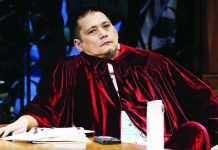




MANILA — Three former Supreme Court chief justices offered similar interpretations Wednesday on how many senator-judges should be counted in determining the two-thirds vote needed to convict Vice President Sara Duterte-Carpio, putting the Senate impeachment court’s 16-vote threshold under closer constitutional scrutiny.
Former chief justices Artemio Panganiban, Hilario Davide Jr. and Reynato Puno argued that the voting base should be limited to senators qualified to participate in the proceedings.
On the other hand, retired Supreme Court Associate Justice Adolfo Azcuna maintained that the Constitution requires the concurrence of two-thirds – or 16 – of all 24 Senate members.
These legal opinions were presented during the 26th day of Duterte-Carpio’s impeachment trial as the Senate sought guidance from the retired magistrates serving as amici curiae, or friends of the court, on one of the most consequential procedural questions facing the tribunal.
Panganiban said senator-judges must actively examine the evidence before exercising their constitutional responsibility to decide the case.
“Active participation and independent evaluation of the evidence are essential to discharge the Senate’s and the Senator’s constitutional responsibility,” Panganiban said.
He stressed that the Senate, as a representative body, must adopt a practical interpretation of the Constitution that allows senator-judges to meaningfully participate in determining the truth.
“As the elected representatives of the Filipino people, the Senate’s mandate demands a commonsensical interpretation of the Constitution. Meaningful adjudication requires active participation in the search for truth and fairness. It is only in this manner that a verdict that is fair to the parties, fair to the senators, and ultimately fair to our sovereign people,” Panganiban said.
Davide took a similar position, arguing that senators who are physically incapacitated, detained or prevented by legal impediments from performing their duties should be excluded from the base used to calculate the required two-thirds vote.
Four of the Senate’s 24 members have not been participating in the impeachment proceedings because of detention, legal circumstances or medical leave.
In his written position read before the impeachment court by Clerk of Court Renato Bantug, Davide cited Supreme Court rulings involving public officials facing criminal cases and detention.
“We have decisions of the Supreme Court which clearly decree that public officers facing criminal cases in court cannot, during the pendency of their cases, practice their profession nor hold office, elective or appointive while in detention. Clearly then, the basis of computing the two-thirds must be the number of senators who are qualified to vote, not the 24 in the present Senate,” Davide said.
“All those disqualified by reason of causes earlier mentioned should not be included,” he added.
Puno, meanwhile, said the relevant provisions of the 1987 Constitution must be read together in determining who qualifies as a “member” for purposes of an impeachment trial.
“They [Articles of the 1987 Constitution] should be considered in determining the proper meaning of the word ‘member’ who will try and decide impeachment cases,” Puno said.
The competing interpretations go directly to the numerical threshold for conviction.
The impeachment court currently operates under Presiding Officer Francis Escudero’s ruling that 16 votes — two-thirds of the full 24-member Senate — are required to convict Duterte-Carpio.
Puno asserted that the 1987 Constitution’s provision on the number of votes required to convict an impeachable officer is flexible, “depending on certain factors.”
“It is inappropriate to give Article 11, Section 3-6 of the Constitution a standalone literal reading. If we give this kind of reading to Article 11, Section 3-6, the threshold of 16 senators to convict will be fixed and immutable,” Puno pointed out.
Puno was answering the court’s question on whether or not the phrase “all members of the Senate” in Article 11, Section 3, Paragraph 6 of the Constitution should refer to the chamber’s full membership of 24 senators.
“However, if that is the intent, Article 11, Section 3-6 should have simply stated that the number of votes to convict is 16. But Article 11, Section 3-6 did not say so. Instead, the language used a fraction,” he told the senator-judges.
“It says two-thirds of all members of the Senate. By using two-thirds, the number of votes to convict will have to move, depending on certain factors,” he declared.
Puno further emphasized that a “strict, standalone, literal interpretation of the provision may “result in absurdities and may result in injustices, which will defeat the purpose of the Constitution.”
In interpreting the Constitution, contextually and functionally, Puno said the senators are, therefore, granted “the flexibility to consider circumstances that will legally prevent a senator from functioning as a member of the Senate.”
“This approach will give the senators the right to consider whether senators who are already dead, resigned, or expelled should still be counted in determining two-thirds of all the members of the Senate,” he noted.
“Also, this approach will enable senators to consider whether senators who are legally incapacitated, like senators charged with plunder, like senators under preventive suspension, should still be counted in determining the number of votes to convict,” the former chief magistrate explained.
Azcuna, however, backed a stricter reading of the constitutional provision and maintained that conviction requires the concurrence of two-thirds of the entire Senate membership.
“No person shall be convicted in an impeachment case without the concurrence of two-thirds of all the members of the Senate,” Azcuna said.
He warned against lowering the number to a simple majority.
“As long as they are members of the Senate, they constitute the denominator in computing the threshold of two-thirds – because all means all,” Azcuna stressed.
Noting that the impeachment process could not only result in the removal, but also a disqualification of an accountable official, Azcuna said that “a decision this hard to undo warrants a higher threshold of agreement than routine business, just as constitutional amendments, treaty ratification, and expulsion of a sitting senator require supermajorities.”
According to him, the framers of “the supermajority-impeachment clause” also feared that impeachment could become “a tool for a transient legislative majority to remove a political rival or an official from a disfavored party, effectively overturning an election result through legislative fiat rather than through the ballot box.”
“A simple-majority threshold would make impeachment conviction achievable by whichever coalition happens to control the chamber at any given moment, collapsing the distinction between “removable for cause” and “removable because we have the votes,” Azcuna said.
Azcuna warned that lowering the threshold to a simple majority “would reward speed and numbers over persuasion and proof.”
As to the question whether a senator-judge who did not attend or substantially participate in the proceedings could still cast a vote on the final question in an impeachment trial, the retired justice said the matter should be decided by the Senate according to its own wisdom.
If he were to be asked, however, Azcuna said those who missed the proceedings should still be allowed to vote since the proceedings are recorded anyway.
The Senate impeachment court is examining whether that threshold should remain based on the full Senate membership or be recalculated according to the number of senator-judges legally qualified to participate and vote in the trial.
The amici curiae were asked to provide independent legal guidance and do not represent either the House prosecution panel or Duterte-Carpio’s defense team./PN