

[av_one_full first min_height=” vertical_alignment=” space=” custom_margin=” margin=’0px’ padding=’0px’ border=” border_color=” radius=’0px’ background_color=” src=” background_position=’top left’ background_repeat=’no-repeat’ animation=”]
[av_heading heading=’Gabriela asks Duterte: Keep ‘sex slave’ statue’ tag=’h3′ style=’blockquote modern-quote’ size=” subheading_active=’subheading_below’ subheading_size=’15’ padding=’10’ color=” custom_font=” av-medium-font-size-title=” av-small-font-size-title=” av-mini-font-size-title=” av-medium-font-size=” av-small-font-size=” av-mini-font-size=” admin_preview_bg=”][/av_heading]
[av_textblock size=” font_color=” color=” av-medium-font-size=” av-small-font-size=” av-mini-font-size=” admin_preview_bg=”]
January 14, 2018
[/av_textblock]
[av_textblock size=” font_color=” color=” av-medium-font-size=” av-small-font-size=” av-mini-font-size=” admin_preview_bg=”]
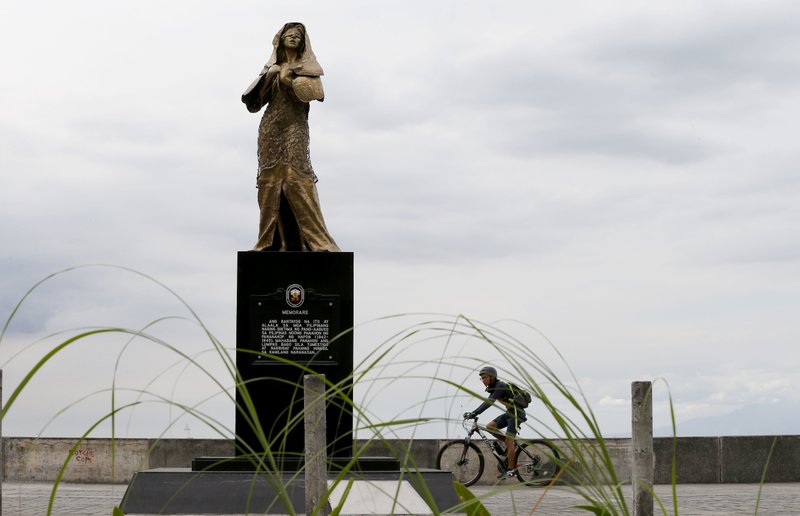
MANILA – Gabriela asked President Rodrigo Duterte to oppose any request by Japan to remove a newly erected statue honoring women who were forced to work in Japanese military brothels during World War II.
Duterte should instead demand an official apology and compensation for Filipino women who were “conscripted by the Japanese Imperial Army to serve as wartime sex slaves,” the women’s group said.
Japanese minister for internal affairs and communications Seiko Noda expressed regret over the construction of the monument in a meeting Tuesday with Duterte in Manila, a Japanese diplomat said, adding that she did not mention any specific request. The diplomat didn’t have authority to brief reporters on the issue and spoke on condition of anonymity.
Unveiled last month, the monument at the Manila Bay features a bronze statue of a blindfolded Filipina wearing a traditional gown.
A National Historical Commission of the Philippines (NHCP) marker says the monument memorializes Filipinas who suffered abuses during the Japanese occupation of the Philippines from 1942 to 1945. It was built with donations from Filipino-Chinese groups and individuals.
“If Japan really wants this issue to be settled and help us all move on and forward, it should officially recognize the horrors of state-sponsored sexual slavery and apologize to the victims,” Gabriela secretary-general Joms Salvador said. “Raising petty issues about statues won’t make this issue go away.”
PROBE PANEL FORMED
A government panel has been formed to look into the issue on the statue, Foreign Affairs secretary Alan Peter Cayetano said.
Cayetano made the announcement on Friday, a day after Duterte’s spokesman said Malacañang will take no action on the statue despite Tokyo’s objection.
A spokeswoman from Japan’s Ministry of Foreign Affairs said on Thursday it was “extremely regrettable” that comfort women statues, including the one in the Philippines, had been erected.
Cayetano said the existence of the monument “will really affect certain feelings and relationships.”
Duterte’s spokesman said on Thursday the statue was not an issue for the president to get involved in, downplaying concern it could hurt ties with Japan.
Cayetano said his department was never consulted about the project approved by the NHCP. The monument was built just a few blocks from the headquarters of the Department of Foreign Affairs.
The panel will be composed of representatives from the Foreign Affairs and Public Works departments, the city government of Manila, and the NHCP.
TIES WITH JAPAN
Duterte has nurtured blossoming relations with Japan and its leader, Shinzo Abe. The emotional issue provides a dilemma for the government’s ties with Tokyo, a major provider of aid and financing to the Philippines.
Historians say 20,000 to 200,000 women from across Asia, many of them Koreans, were forced to provide sex to Japan’s front-line soldiers.
Japanese nationalists contend that the so-called “comfort women” in wartime brothels were voluntary prostitutes, not sex slaves, and that Japan has been unfairly criticized for a practice they say is common in any country at war.
In 1995, Japan provided through a private fund 2 million yen ($18,000) each to about 280 women in the Philippines, Taiwan and South Korea, and funded nursing homes and medical assistance for Indonesian and former Dutch sex slaves.
Many women in South Korea and the Philippines have demanded a full apology accompanied by official government compensation. (AP and Reuters)
[/av_textblock]
[/av_one_full]