

[av_one_full first min_height=” vertical_alignment=” space=” custom_margin=” margin=’0px’ padding=’0px’ border=” border_color=” radius=’0px’ background_color=” src=” background_position=’top left’ background_repeat=’no-repeat’ animation=”]
[av_heading tag=’h3′ padding=’10’ heading=’Deaths in vaccine mess ‘consistent with dengue,’ says DOH’ color=” style=’blockquote modern-quote’ custom_font=” size=” subheading_active=’subheading_below’ subheading_size=’15’ custom_class=” admin_preview_bg=” av-desktop-hide=” av-medium-hide=” av-small-hide=” av-mini-hide=” av-medium-font-size-title=” av-small-font-size-title=” av-mini-font-size-title=” av-medium-font-size=” av-small-font-size=” av-mini-font-size=”][/av_heading]
[av_textblock size=” font_color=” color=” av-medium-font-size=” av-small-font-size=” av-mini-font-size=” admin_preview_bg=”]
January 14, 2018
[/av_textblock]
[av_textblock size=” font_color=” color=” av-medium-font-size=” av-small-font-size=” av-mini-font-size=” admin_preview_bg=”]
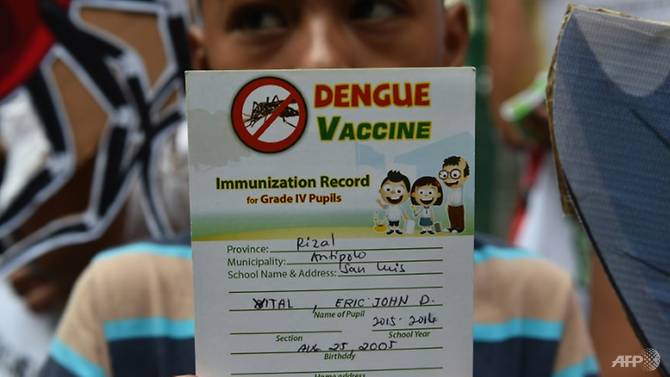
MANILA – Some of the 14 children who died after receiving a controversial vaccine showed signs of “severe dengue,” the Department of Health said, as investigators probe the drug whose use was suspended due to health concerns.
More than 830,000 Filipino schoolchildren were injected with Sanofi’s Dengvaxia vaccine in 2016 in the world’s first public dengue immunization program.
But the country stopped the sale and distribution of Dengvaxia in December 2017 after Sanofi warned the vaccine could worsen symptoms for people who had not previously been infected with the virus.
Authorities were also pursuing criminal and public health safety investigations into any links between the drug and the deaths of 14 schoolchildren who died months after being vaccinated.
“The findings of the forensic pathologists are consistent with severe dengue or dengue shock syndrome,” Health secretary Francisco Duque said in a television interview on Jan. 11, referring to the results of autopsies on some of the deceased children.
Duque also said he had asked Sanofi to refund around P1.5 billion (US$30 million) worth of unused vaccines.
Officials at the Public Attorney’s Office, which has been conducting autopsies on some of the dead children, have been trying to build a criminal case by proving the deaths were linked to the vaccine.
The Health department has also commissioned independent experts to pursue a separate inquiry in the interest of public health and safety, though the results of this study have not been disclosed.
“They may or may not be investigating the same cases or deaths and would be using different methods of investigation,” Health undersecretary Eric Tayag said.
Sanofi said in a statement on Jan. 11 that it was “saddened” to learn of the deaths of the children.
“Up to this date, there has been no death established to have been causally linked to the dengue vaccine, not even among the 40,000 people involved in the clinical trials conducted across 15 countries,” the statement added.
In November last year, the French company released findings of a new study that showed Dengvaxia could lead to severe infections for vaccinated people who caught dengue for the first time.
The disclosure triggered a public furor, with some parents blaming the vaccine for their children’s deaths and a number of legislators accusing the government of endangering public health.
Dengue, a mosquito-borne illness, is a leading cause of serious illness and death among children in some Asian and Latin American countries, according to the World Health Organization. (AFP)
[/av_textblock]
[/av_one_full]