



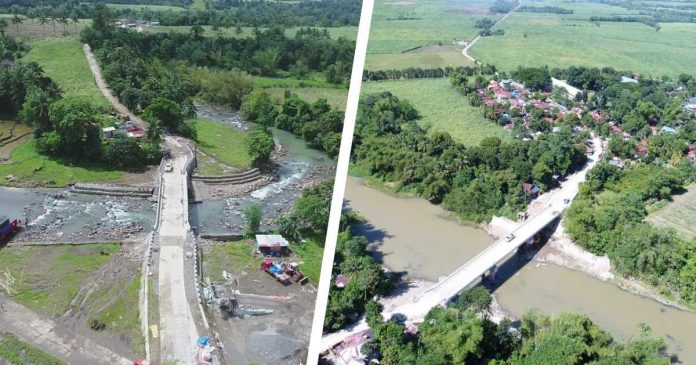
BACOLOD City – Two bridges worth P74.7 million make travel easier and safer for residents of remote villages in E.B. Magalona town, Negros Occidental.
The P24.7-million Sitio Calaptan Bridge and the P50-million reconstruction of the Nanca-Cudangdang Bridge, completed in January and April of this year, connect communities across the Malogo River.
Department of Public Works and Highways (DPWH) in Western Visayas director Nerie Bueno said the two-lane Sitio Calaptan Bridge now allows residents of barangays Canlusong and San Isidro to safely cross the river after previously using only an old overflow bridge.
Barangay Canlusong, located some 25 kilometers from the town proper, is considered the farthest village in the northern Negros municipality.
Officer-in-charge District Engineer Dene Baldonado Jr. of the Negros Occidental 1st District Engineering Office said the Malogo overflow bridge was already dilapidated.
“Malogo River is mostly calm but hazard during the rainy season. It suddenly shifts from low discharge to raging currents,” he said.
Earlier, the 1st District Engineering Office also completed the reconstruction of the Nanca-Cudangdang Bridge, which reconnected four villages with 11,000 residents, severely hit and isolated by Typhoon Yolanda in 2013. These are the barangays of Nanca and Cudangdang, and the adjacent barangays of Tanza and Tabigue.
The bridge provides direct access for sugarcane-hauling trucks from these villages to Victorias City, according to Bueno.
“Previously, it was done using a small barge, which put passengers at risk during heavy rains or typhoons,” Bueno said. (PNA)/PN