

MANILA – The Philippines and Japan agreed to a Reciprocal Access Agreement (RAA) to heighten defense cooperation between the two countries amid tensions in the West Philippines Sea.
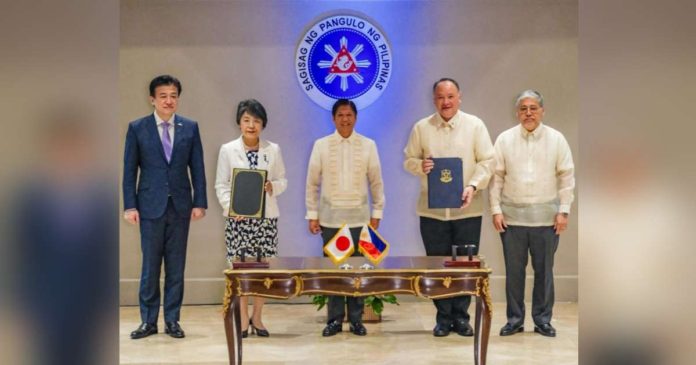
The signing of the landmark agreement was done during Japanese Foreign Minister Kamikawa Yoko and Defense Minister Kihara Minoru’s courtesy call to President Ferdinand “Bongbong” Marcos Jr.at the Malacañang Palace on Monday.
The first formal negotiations between Philippines and Japan were held in Tokyo in November last year with the Department of National Defense (DND), Department of Foreign Affairs (DFA) and the Department of Justice (DOJ) leading the way.
Last month, a virtual line-by-line reading of the RAA main text, the Agreed Minutes, and two records of discussions were held, according to the Presidential Communications Office (PCO).
Under the RAA, more Japanese forces will be allowed to join annual military exercises involving the Philippines and the US, including the “Balikatan” exercises.
The landmark agreement between the two countries will also allow Japanese forces to provide humanitarian assistance to the Philippines when needed.
The newly-signed agreement still needs the ratification of the Philippine Senate and the National Legislature of Japan before it takes effect.
Japan has been vocal in expressing alarm over the rising tensions in the West Philippines Sea, noting that the peace and stability in the region is an international concern.
The Philippines, China, Taiwan, Vietnam, Malaysia and Brunei have been embroiled in years-long territorial disputes over resource-rich features in the contested waters.
China has since claimed the waters nearly in its entirety despite an international tribunal ruling on a case filed by the Philippine government, which invalidated such assertion./PN