



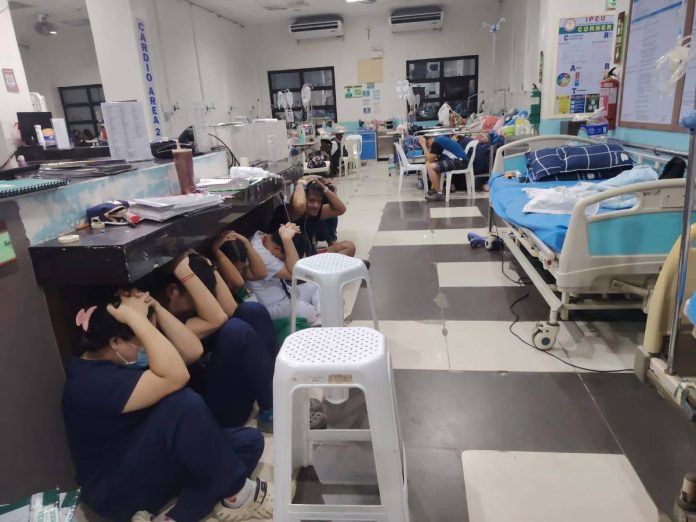
ILOILO City – The Office of Civil Defense (OCD) in Western Visayas is urging hospitals and other establishments across the region to conduct regular earthquake and disaster response exercises, warning that preparedness plans are only effective if they are repeatedly tested under realistic conditions.
The call came after the agency used the second-quarter Nationwide Simultaneous Earthquake Drill (NSED) on June 18 to assess the readiness of the Western Visayas Medical Center (WVMC) in Mandurriao, Iloilo City, through a full-scale disaster response exercise designed to evaluate whether existing emergency protocols can actually work during a real crisis.
According to Atty. Melissa Banias, chief of the Disaster Risk Reduction and Management Division and chief of the Operations Section of OCD Region 6, disaster preparedness plans cannot be considered reliable unless they are subjected to regular drills and exercises.
“The plan is just one and partial of the entire preparation nila so that’s why to ensure nga ang plan nila gina-practice, or ang plan nila operational or ang plan nila is feasible nga puede nga ma-implement is to test is. So, isa sa mga test is through the conduct of the drill,” Banias told Panay News.
Banias said the agency is advocating for establishments, particularly hospitals, to institutionalize testing and exercise activities as part of their regular programs instead of conducting them only during the quarterly NSED.
She said drills provide an opportunity to determine whether disaster risk reduction and management (DRRM) plans, policies and protocols are practical, efficient and capable of being implemented during actual emergencies.
WVMC was selected as the pilot site for the region’s second-quarter earthquake drill to evaluate its readiness and determine the effectiveness of its disaster response plans.
Although hospitals are primarily governed by Department of Health regulations, Banias stressed that all institutions should regularly test their emergency plans.
“Ang hospitals may ara na (sang plan) kay may regulatory agency man kita nga naga-govern dira. But then again amo na ang challenge naton nga i-test how effective and efficient ang isa ka plan, if doable or feasible,” she said.
Banias noted that hospitals generally already have disaster preparedness and response plans, along with inventories, assets and resources needed for emergency operations. Many also participate in the Gawad KALASAG Awards, the country’s highest recognition for excellence in disaster risk reduction and management and humanitarian assistance.
Asked whether WVMC was prepared to respond to a major earthquake, Banias said the hospital had the necessary plans and systems in place, although a complete assessment would require evaluating the performance of all participating agencies involved in the exercise.
As part of the simulation, responders carried out High-Angle Rescue, Hazardous Materials (HazMat) response, and Collapsed Structure Search and Rescue operations.
The evaluation was led by OCD-6 together with representatives from the Bureau of Fire Protection, the Philippine Army’s 301st Infantry Brigade, Department of Social Welfare and Development, and Department of Public Works and Highways.
Participating response units included the local and provincial disaster risk reduction offices, Urban Search and Rescue teams, the Philippine Red Cross, FedFire, and the Iloilo Citizens Action Group./PN