



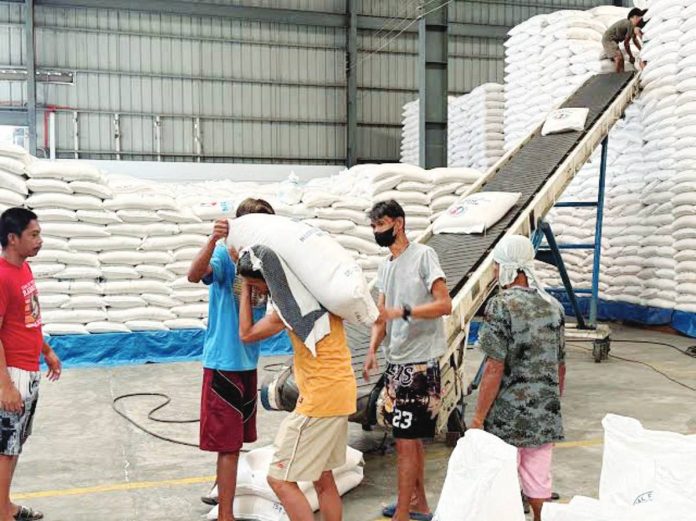
AGRICULTURE Secretary Francisco Tiu Laurel Jr. said Tuesday, September 2, the government is closely monitoring rice traders following the implementation of a 60-day import ban on regular and well-milled rice, warning that abusive importers could lose their permits.
In an interview on “Unang Balita,” Laurel noted that rice prices in local markets have fluctuated since the ban took effect, with some imported varieties being sold at inflated rates despite cheaper options being available.
“Nakita din namin sa palengke may imported rice na P48, P47 [per kilo], dating P43 to P45. Pero may imported at P35, P38, P40, P42. So technically sa mamamayan natin ‘yan sana huwag din bilhin ang mahal… Mayroon mas mura na halos pareho lang quality sa mahal,” he said.
He urged consumers to be more discerning with their purchases, while assuring that the Department of Agriculture (DA) is monitoring rice retailers’ compliance with the ban.
“Kaya pakiusap ko sa ating consumers na tingnan mabuti ang bigas at puwede maganda rin ang mga mas mura na imported. So umiikot kami at mino-monitor namin ang mga import. At nakausap din namin ang importers association at warning namin sila kung umabuso sila dito, baka i-blacklist din namin sila o tanggalin namin sila ng import permit in the future,” he noted.
Meanwhile, Laurel said the import ban has given a temporary boost to farmers, with farmgate prices of palay rising after President Ferdinand “Bongbong” Marcos Jr. announced the move.
“Bago in-announce ‘yan mayroon tayong palay na P8 to P10 [per kilo]. Nu’ng in-announce ‘yan ng ating Pangulo umakyat ng P14 to P15. Mayroon naman ibang lugar umakyat na P8 to P10 to P12 to P13. So nakatulong naman although kulang pa rin,” he said.
The Agriculture chief clarified that the 60-day ban is a temporary measure, emphasizing the need to amend the Rice Tariffication Law (RTL) as a long-term solution.
The 60-day rice import ban took effect this week as part of government efforts to stabilize local farm gate prices and protect Filipino farmers.
The Philippine Rice Industry Stakeholders Movement had warned, however, that the ban may actually cause rice retail prices to rise because of the expected increase in local supply.
Based on its projections, palay or unmilled rice produced by local farmers will rise by P1 to P2 per kilo and cause higher retail prices by the price range.
The Philippine Statistics Authority (PSA), however, sees that retail prices of rice would decline in the next four months. (GMA Integrated News)