


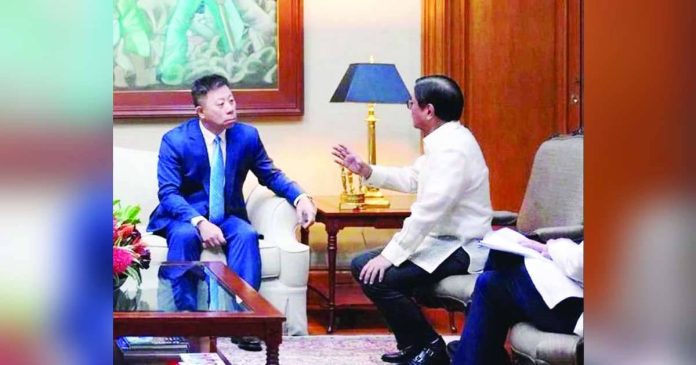
MANILA — President Ferdinand Marcos Jr. is seeking an explanation from Chinese Ambassador Jing Quan after the diplomat declared that Beijing could easily win a military confrontation, a statement the President described as a possible threat amid continuing tensions between the Philippines and China over the South China Sea.
Marcos said Friday that the ambassador’s remarks were inappropriate and warranted a direct discussion, raising fresh diplomatic concerns over Beijing’s increasingly assertive posture in the disputed waters.
“Well, it sounds very much to me like a threat, and it is not a very diplomatic statement to be made. So we perhaps would like to understand what exactly it is that he means,” Marcos said during an interview at the Philippine Coast Guard’s 125th founding anniversary celebration.
Asked whether he intended to summon the Chinese ambassador to explain his statement, the President replied: “I think that deserves a discussion between Ambassador and myself.”
The controversy erupted after Jing, speaking to reporters Thursday following a speech at Diliman Preparatory School in Quezon City, suggested that China possessed the military capability to prevail in a confrontation but preferred to maintain peace.
“If we want to use force, we may easily win. But no, we will not use force. You know, we love peace, and in this region, we enjoy the peace,” Jing said.
Although the ambassador subsequently clarified that Beijing had no intention of using force against neighboring countries, his initial remarks drew criticism from the Philippine government, which viewed the statement as potentially threatening.
The Department of Foreign Affairs (DFA) described Jing’s comments as “regrettable,” warning that such language could undermine diplomatic efforts to manage the already strained relationship between Manila and Beijing.
The DFA stressed that foreign diplomats must exercise caution and restraint in their public pronouncements, particularly when discussing sensitive issues involving territorial sovereignty and unresolved maritime disputes.
“The business of diplomacy requires tact and restraint in order to create space necessary for discourse, dialogue and engagement, regardless of the disparity in positions or perspectives,” the department said.
The Philippine government also reminded foreign diplomatic representatives that inflammatory statements could erode mutual trust and complicate efforts to resolve disagreements through peaceful negotiations.
The latest diplomatic friction comes against the backdrop of persistent tensions in the South China Sea, where Philippine and Chinese vessels have repeatedly figured in confrontations over competing maritime claims.
The Philippines and China are among the claimants in the strategically important waterway, alongside Vietnam, Malaysia, Brunei and Taiwan.
The dispute has remained a major source of friction between Manila and Beijing despite continuing diplomatic engagements aimed at preventing maritime incidents from escalating into a wider confrontation.
In 2016, an international arbitral tribunal in The Hague ruled in favor of the Philippines, finding no legal basis for China’s expansive claims to historic rights over resources within areas covered by its so-called nine-dash line.
Beijing has consistently rejected the ruling and maintained its maritime claims, prolonging the dispute despite Manila’s repeated assertions of its rights under international law.
Marcos’ decision to seek clarification directly from Jing signals the administration’s concern over rhetoric that could be interpreted as a warning of military action, even as both governments profess their commitment to peaceful engagement.
The planned discussion also places renewed attention on whether Beijing’s diplomatic assurances of peace are consistent with the statements of its representatives and its conduct in disputed waters.
For Manila, the immediate issue is whether the Chinese envoy’s remarks were merely an ill-chosen expression of military confidence or an implicit warning directed at countries challenging Beijing’s maritime claims.
The President has made clear that the distinction deserves an explanation from the ambassador himself./PN