
BY NELJOY N. GALIGAO
IN JOURNALISM, legacies are often measured in front pages, breaking stories and decades of publication.
But for those who worked under the late Daniel “Danny” Gumban Fajardo, founder of Panay News, his most enduring legacy cannot be found in an archive.
It can be found in the people he helped shape.
For many former Panay News journalists and employees, the newsroom was more than a workplace. Under Sir Danny’s leadership, it became a place where young reporters discovered their capabilities, employees found courage to pursue bigger dreams, and ordinary workers were encouraged to become better versions of themselves.
Sir Danny was not simply a publisher or an executive who managed a newspaper. He was, in the words and memories of those he mentored, a person who recognized potential—and gave people the opportunity to realize it.
His gift was not merely seeing what people were at the time.
It was seeing what they could become.
A boss who believed in dreams
For Atty. May Rago-Castillo, that belief changed the course of her life.
Rago-Castillo joined Panay News in June 2000 as a young reporter. It was her first job, and like many young journalists starting out, she was focused on learning the craft, meeting deadlines and covering the news.
But she also carried another dream: to study law.
When she approached Sir Danny about pursuing her legal education, she promised to finish her news reports early so she could attend evening classes.
Sir Danny did more than simply allow her to pursue the dream. He supported it.
He gave her a weekly stipend on top of her salary to help with her studies—a gesture that Rago-Castillo would remember long after leaving the newsroom.
Sir Danny even saw possibilities beyond law. With his characteristic humor and instinct for people, he once told her that her name, “May Rago,” was short and easy to remember—good, he joked, for someone who might someday run for office.
Rago-Castillo never had political ambitions. But what stayed with her was not the suggestion that she could become a politician. It was Sir Danny’s deeper message: she was capable of becoming more.
“He propels people to grow. He has this energy of allowing people to grow and expand. He has a generous heart and he values his people,” Rago-Castillo said.
“He set me out for life, in a way. He allowed me to go and serve the government,” she added.
That opportunity eventually led to a two-decade career with the Department of Social Welfare and Development before she became a practicing lawyer.
For Rago-Castillo, the kindness Sir Danny extended to her became something she could carry forward.
“After that, I served the public for the next 20 years as a DSWD employee,” she said.
“In my stint at DSWD, and even now as a practicing lawyer, I pass on the kindness—the way DF did, as I am a product of kindness myself.”
In that sense, Sir Danny’s investment in one young reporter did not end when she left the newspaper.
It multiplied.
Trusting those who were just starting out
Sir Danny’s ability to recognize potential was not limited to employees who already showed exceptional promise.
Sometimes, he simply took a chance.
Montesa Caoyonan-Griño remembers being a fresh graduate when she sat across from Sir Danny for an interview for a field reporter position.
She had little experience in writing and could have tried to impress her prospective employer with an exaggerated account of her abilities.
Instead, she told him the truth.
“Panay News was my first home when I entered the media industry. When Boss Danny Fajardo personally interviewed me for a field reporter position, I honestly told him that, as a fresh graduate, I did not have extensive experience in writing,” she recalled.
But she also told him she was willing to learn.
Sir Danny hired her.
That simple decision became a turning point in her life.
“But I assured him that if given the chance, I am willing to learn. That trust DF gave me helped mold me into the person I am today,” Caoyonan-Griño said.
More than eight years at Panay News taught her not only the mechanics of journalism but also resilience—the ability to face pressure, overcome challenges and keep moving forward.
The experience also gave her professional networks and life lessons that would later prove valuable when she entered public service.
Months before Sir Danny died, fate gave her one more opportunity to see him.
They crossed paths at the Manila airport while waiting for a flight back to Iloilo.
For Caoyonan-Griño, it was a chance to tell him something that perhaps former employees do not always get to say to their mentors: thank you.
Before they parted, Sir Danny shared a phrase that reflected his philosophy of work and his concern for the people who made Panay News possible:
“Dapat tanan makakaon man sang atay kag batikulon.”
Behind the humor was a serious principle—that everyone in an organization, whether in sales, production or reporting, should work together and share in the rewards of their collective effort.
For Caoyonan-Griño, it was quintessential Sir Danny.
“For me, DF’s greatest legacy was his kindness,” she said. “That was what I learned from him from the very beginning, and that is how I will always remember him.”
“Thank you, Boss Danny Fajardo. Your kindness and trust helped shape the person I have become.”
A boss who listened
Sir Danny’s influence was not confined to journalists.
His concern extended across the organization, reaching employees whose work rarely appeared on the front page but whose efforts kept the newspaper running.
Bernadeth Bernardo spent three decades with Panay News after joining its marketing department at 28.
For 30 years, she witnessed Sir Danny not only as the head of the company but as a boss whom employees could approach when life became difficult.
For Bernardo, Sir Danny was the kind of employer who listened.
“Sir DF is the best boss. Ara gid siya kung kinahanglan mo ang bulig. Open gid siya sa mga empleyado kon may mga problema,” she recalled.
What she remembers most is his willingness to hear employees out and offer advice when they were struggling.
“He was kind and genuinely concerned about his employees,” she said.
That accessibility mattered.
In an industry often associated with deadlines, pressure and demanding personalities, Sir Danny’s open-door approach gave employees something equally important: the assurance that they were seen not merely as workers, but as people.
For Bernardo, that human connection was a major reason for three decades of loyalty.
More than a newspaper
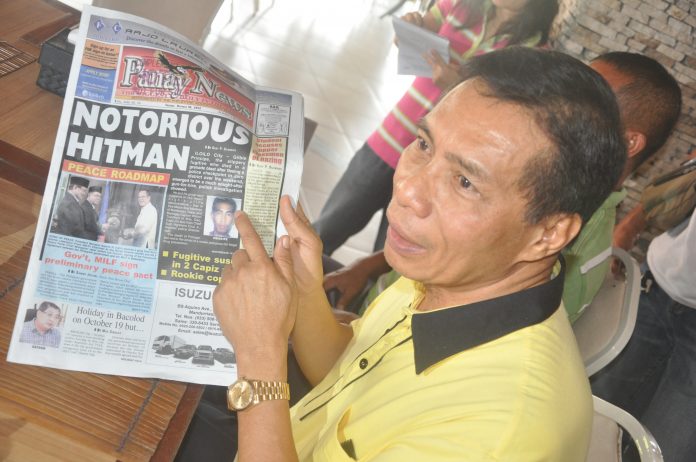
Sir Danny built Panay News into a regional institution.
But perhaps his greatest accomplishment was something that could never be measured by circulation figures.
He built people.
He encouraged a young reporter to study law. He gave an inexperienced graduate a chance. He listened to employees facing personal difficulties. He trusted people to grow, even when they were still discovering their own potential.
The careers that followed became part of the larger story.
Some entered government. Some pursued professional careers. Others continued working in journalism and other fields.
Their paths may have diverged from the newsroom, but they carried something with them.
A lesson.
A kindness.
A confidence that someone had once believed in them.
That is why Sir Danny’s legacy extends beyond Panay News’ pages.
It lives in courtrooms where former journalists practice law, in government offices where former employees serve the public, and in newsrooms where lessons learned from him continue to influence how people work and treat one another.
A newspaper can preserve a story in print.
A good mentor preserves something deeper—in people.
And for those who knew Daniel “Danny” G. Fajardo, his most important stories may not have been the ones published under his name.
They were the lives he helped set in motion.
His ink may have faded from the pages, but the character he helped build continues to write the next chapters./PN