


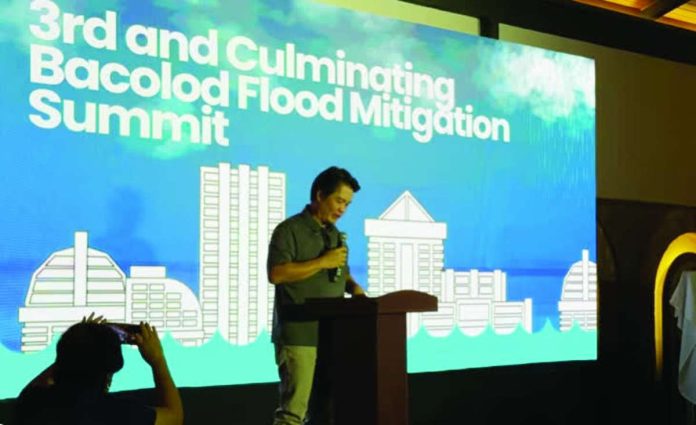
BACOLOD City — Bacolod City’s Lone Congressional District took a major step toward addressing its long-standing flooding problems with the launch of a digital flood management platform and the presentation of a comprehensive flood resiliency roadmap during the Third and Culminating Bacolod Flood Mitigation Summit on June 9.
Led by the Office of Lone District Congressman and Deputy Speaker Alfredo Abelardo Benitez, the summit gathered representatives from government agencies, technical experts, civil society organizations, community leaders, and other stakeholders to formalize a unified strategy for reducing the impact of flooding in the city.
A key highlight of the event was the unveiling of a digital platform that will serve as a central repository of flood-related information, including historical flood events, scientific studies, engineering solutions, proposed interventions, and ongoing mitigation projects.
More than just a database, the platform is envisioned as a dynamic tool for collaboration, coordination, and accountability. It will enable government agencies, experts, stakeholders, and local communities to share information, monitor project implementation, and build on the knowledge generated throughout the flood mitigation planning process.
“Flood mitigation cannot be a one-time undertaking,” Benitez said, emphasizing the need for sustained commitment, continuous learning, and collective action.
The summit marked the culmination of a series of consultations and planning sessions that began with the first Bacolod Flood Mitigation Summit in October 2025.
The initiative was launched to formulate a long-term Flood Mitigation Master Plan aimed at addressing one of the city’s most persistent challenges.
“The master plan will serve as the city’s blueprint in solving our long fight against flooding,” Benitez said.
During his address, the congressman stressed that while flooding remains a global challenge, Bacolod should not accept it as an unavoidable reality.
“The fact that flooding happens elsewhere does not mean we should simply learn to live with it,” he said. “Instead, it should challenge us to think differently, act decisively, and find ways to eliminate or significantly reduce its impact on our communities.”
Benitez challenged stakeholders to make Bacolod a model of flood resilience by harnessing science, innovation, environmental stewardship, and collective action.
Through the series of flood mitigation summits, participants identified flood-prone areas, analyzed contributing factors, and explored both green and gray infrastructure solutions to protect communities while preserving the environment.
The resulting roadmap adopts a whole-of-government and whole-of-society approach to flood management, integrating recommendations from government agencies, experts, and local communities.
Following the presentation of the roadmap, participants signed a commitment pledge affirming their support for its implementation.
Benitez disclosed that he has formally requested national government agencies to prioritize and strictly implement flood control projects identified in the roadmap.
The project list was consolidated from proposals generated during the previous two flood mitigation summits.
He also said he is lobbying for funding support for Bacolod’s flood control initiatives under the 2028 national budget.
According to the lawmaker, the roadmap’s short-, medium-, and long-term projects are estimated to cost approximately P6 billion and will require several years to complete.
A substantial portion of the proposed investments will focus on the Banago and Mandalagan rivers, which were identified as critical contributors to major flooding incidents in the city.
Despite the summit being described as the culminating gathering of the flood mitigation initiative, Benitez stressed that the work is far from over.
“Let us not waver in our resolve. Let us continue refining our plans, improving our systems, and working together long after this summit has concluded,” he said.
“The roadmap we present today is not a final destination—it is part of an ongoing journey toward a safer, smarter, and more flood-resilient Bacolod.”
Benitez underscored that flood mitigation extends beyond infrastructure projects such as drainage systems, pumping stations, canals, and flood control structures.
“This is about protecting lives. It is about protecting homes, livelihoods, businesses, and the future of our city,” he said.
He added that the roadmap is grounded in the lived experiences of Bacolod residents, guided by science, strengthened through cooperation, and anchored on a shared responsibility to protect the environment.
“Together, we are laying the foundation for a safer, more sustainable, and flood-resilient Bacolod,” Benitez said./PN