


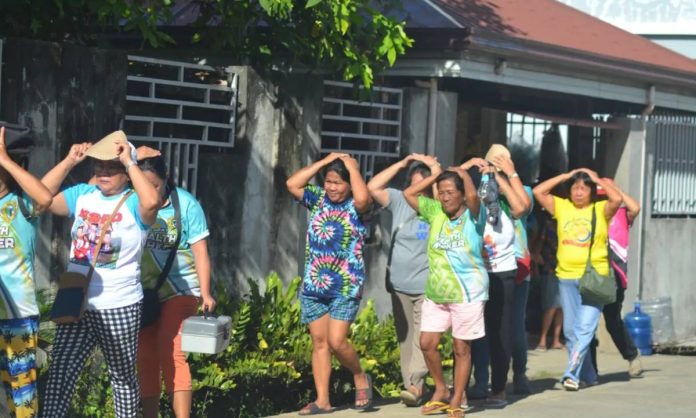
ILOILO – In coastal Banate, the ringing of church bells on Thursday afternoon, October 23, was no ordinary call to prayer — it was a lifeline.
As part of a region-wide earthquake and tsunami drill, Iloilo Province showcased how local tools and community cooperation can save lives when disaster strikes without warning.
The Iloilo Provincial Government, through the Provincial Disaster Risk Reduction and Management Office (PDRRMO), led the exercise in partnership with the Municipal Government of Banate.
The simulation covered barangays Talokgangan and Carmelo, where residents, using their own community-based tsunami warning system, responded swiftly to alarms signalling a magnitude 7.2 earthquake followed by an incoming tsunami.
Instead of high-tech sirens, the local church bells served as the alarm — a traditional but highly effective tool to alert residents across the municipality to evacuate to safer ground.
“This shows that preparedness doesn’t always require expensive equipment,” said one of the organizers. “What matters is that communities know their system and act fast together.”
Panay Island is highly vulnerable to intense seismic activity due to the West Panay Fault, a significant geological fault line. It stretches over 90 kilometers, traversing towns in Iloilo (San Joaquin, Miag-ao, Igbaras, Tubungan, Leon, Alimodian, Janiuay, Lambunao), Antique (Sibalom, San Remigio, Valderrama, Pandan), Capiz (Tapaz, Jamindan), and Aklan (Libacao, Madalag, Malinao).
While most of Iloilo Province is landlocked, retired police colonel Cornelio Salinas, head of the PDRRMO, warned that coastal barangays — from San Joaquin town in the south to Carles in the north — should prepare for possible tsunami impacts, especially if a major quake strikes the Negros Trench.
“Our coastal areas should be prepared. It will happen — and if it does, what should we do? We must know our coping mechanisms,” he said, noting that the office continues to assess data from national agencies to refine projections.
The earthquake drill saw active participation from the Bureau of Fire Protection (BFP), Philippine National Police (PNP), Philippine Coast Guard (PCG), Municipal Health Office (MHO), barangay officials, and volunteers. Observers from the Office of Civil Defense (OCD) Region 6 later provided technical feedback at a post-drill briefing in Barangay Carmelo.
OCD Region 6 director Raul Fernandez praised the participants, saying familiarity and practice are key to saving lives.
“Familiarity breeds confidence,” he said. “Knowing what to do and where to go during an earthquake significantly reduces the likelihood of panic during emergencies.”
The exercise formed part of the two-day region-wide earthquake and tsunami drill organized by the Regional Disaster Risk Reduction and Management Council (RDRRMC), which covered Antique, Iloilo Province, and Iloilo City on October 23, followed by Aklan, Capiz, and Guimaras the next day.
The most potent earthquake ever recorded on Panay Island occurred on January 25, 1948 — a magnitude 7.8 tremor dubbed the “Lady Caycay” earthquake.
Centered near Anini-y, Antique, its Mercalli intensity reached X (“Extreme”), ripping open fissures across Iloilo and Antique, and causing a small tsunami that reportedly killed two along the Iloilo Strait.
The destruction was widespread, and more evident on Spanish-era churches — 55 were hit and 17 collapsed outright. In Iloilo alone, belfries of historic churches in Jaro, San Joaquin, Arevalo and others toppled.
Reports at that time told of approximately 21 fatalities and 43 injuries.
Infrastructure failures included ground fissures up to four meters wide, and collapsing bridges and buildings.
The “Lady Caycay” earthquake remains the second-strongest in Philippine history, surpassed only by the 7.8 magnitude event near Luzon in 1990.
The earthquake drill, held amid a string of strong earthquakes in Cebu, Davao, and Zambales, underscored the importance of community-based warning systems and grassroots participation in disaster response — proving that resilience can begin with something as simple, and as powerful, as a ringing bell./PN