


ILOILO City – Long after the solemn rituals of Lent have faded and Holy Week processions have returned to memory, a quiet yet powerful space inside the University of San Agustin (USA) continues to echo with stories of sacrifice, devotion, and time itself.
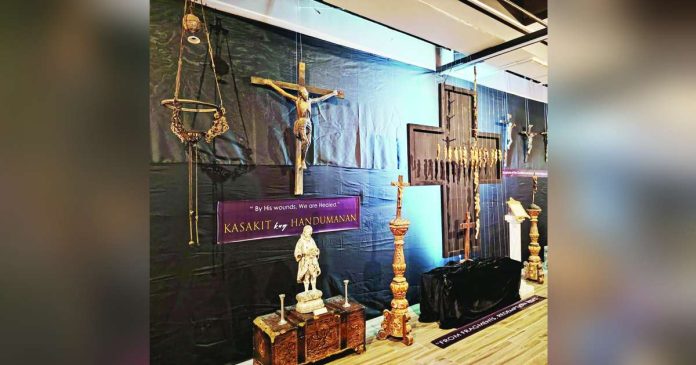
On the third floor of the Fray Luis De Leon, OSA Building, the USA Archives and Museum houses an exhibition that refuses to be confined by the calendar. “Kasakit kag Handumanan sa Kuwaresma,” which opened on March 24, 2026, and runs until April 30, stands not merely as a seasonal display — but as a lingering meditation on faith that endures beyond Lent.
At first glance, the collection may appear fragile — worn wooden sculptures, fractured limbs, faded finishes, and missing fragments. But look closer, and these are not signs of neglect. They are marks of survival.
They are stories.
They are memory.
The exhibition features a deeply personal collection donated by Ma. Luisa Jesena-Santa Maria, heir to the cherished religious artifacts of Leticia Javellana Jesena. What began as a childhood fascination grew quietly over decades into a repository of faith, now shared with the public in a gesture that is as generous as it is symbolic.
“I am here to offer my personal, my mother’s collections. This collection was when I am about nine years old. Over the decades, it quietly grew alongside my life; each of these carries not just religious meaning but also the memories of my mother, Leticia Javellana Jesena, where faith and devotion and love lead me to preserving this artifact. Now, at 71, I feel that it is time for these treasures to find a new home for a greater purpose,” Jesena-Santa Maria shared.
Her decision is shaped not only by nostalgia but by necessity — and a vision for continuity.
“My siblings and I are no longer in Iloilo, and grandchildren are abroad. Rather than keeping this collection private, we choose to share it so it may continue to live, inspire, and be appreciated — to be sensible to students, scholars, and the public, allowing others to learn from it, reflect from it, and even find meaning,” she added.
In this space, faith is not polished. It is raw, imperfect, and deeply human.
Architect Adonis C. Canonicato invites visitors to reconsider what they see — not as broken relics, but as vessels of endurance.
“To those who may not understand art or collecting, it might seem like ‘this looks like trash’, as many pieces appear broken. However, when we see these items, we shouldn’t disregard them; instead, we should preserve them. The scars and damage on these objects are intentionally showcased to highlight the message that God and faith endure, even when form is imperfect,” he explained.
Here, damage is not concealed — it is honored.
“Brokenness carries significance. Instead of hiding imperfections, this exhibition celebrates history, allowing it to remain visible as a form of handumanan or remembrance. Ultimately, the exhibition emphasizes preservation as a way of ensuring continuity. The USA Archives and Museum is dedicated not just to preserving objects, but also the memories, emotions, and identities attached to them,” Canonicato added.
Each sculpture — whether a crucifixion figure or an ornamental panel — becomes more than an artifact. It becomes a witness. A silent chronicler of prayers whispered across generations, of hands that once held it in devotion, of time that refused to erase its meaning.
For Rev. Fr. Dominador Besares, OSA-Archivist and Curator, the exhibition’s message transcends the season that inspired it.
“This exhibit serves as a reminder for everyone to reflect on the pain, suffering, and sacrifices of the Lord, particularly His death on the cross. During this Lenten season, we present a unique collection of colonial-era crucifixes and artifacts from the time of the friars. For the local community, these images are both revered and beloved. These sacred images bear the scars of time and neglect,” he said.
Even outside Lent, the invitation remains the same: to pause, to reflect, to remember.
Dr. Vicente S. Solas underscores this enduring relevance, pointing to the exhibition’s deeper narrative.
“This exhibition pays tribute to the sacred narrative of Lent, showcasing a captivating collection of centuries-old works that reflect the deep spiritual journey observed during this significant period. Each piece, while steeped in history, carries its own unique imperfections that add to its character and authenticity…this vividly illustrate the themes of reflection, sacrifice, and renewal that define Lent,” he said.
Behind the scenes, careful conservation efforts ensure that these fragile pieces continue to survive — stabilized, restored where necessary, yet never stripped of their authenticity. The goal is not to make them look new, but to let them remain true.
And perhaps that is the quiet triumph of “Kasakit kag Handumanan sa Kuwaresma.”
It does not end with Lent.
It lingers — in the cracks of wood, in the fading paint, in the spaces between absence and presence.
In a world that often seeks perfection, this exhibition offers something far more profound: a reminder that faith, like these artifacts, is not diminished by its scars.
It is defined by them./PN