
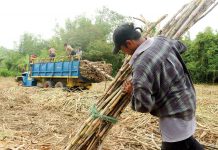



THE SPIRALING of fuel prices is a “favorite” topic by some national candidates who visit Bacolod and Negros. Of course, it’s a given actuality due to the ongoing Russia-Ukraine war.
But what “appalled” me were the statements of Senate Majority Leader Juan Miguel “Migz” Zubiri during a press conference at Nature’s Village in Talisay City on Tuesday, March 8.
Aside from calling for the immediate suspension of fuel excise tax, Migz said he wanted the government to strongly implement (now) the Biofuel Acts of 2006.
Migz was the principal author of the said law. And he said, “I authored Biofuels Act because I wanted to create an alternative fuel program. Unfortunately, the government never fully supported it…We have the law in place, we just need full government implementation to start our shift towards alternative fuels….As to what we are seeing now, we cannot afford to be dependent on imported fuels.”
That’s why Migz stressed, “We have to cultivate our fuel industries, and ensure that we have sustainable fuel sources that our people can depend on at all times.”
Questions:
* Why did the government suspend the implementation of Republic Act 9367 or Biofuels Act of 2006?
* What went wrong?
* Didn’t Migz know the bad impacts that the Biofuels Act of 2006 may cause to human lives and the environment?
Hope he did an extensive research on the matter prior to proposing such into a law.
Let’s dissect the issues hounding this Migz’s controversial Act.
The Biofuel Acts of 2006 was signed into law by then President Gloria Macapagal-Arroyo on Jan. 12, 2007.
Such is aimed at reducing the country’s dependence on imported fuel with due regard to the protection of health, environment and natural ecosystem. And, too, must be consistent to the country’s sustainable economic growth by way of expanding opportunities for livelihood.
And two of its main purposes are – (1) mitigate toxic and greenhouse gas (GhG) emissions and (2) develop and utilize indigenous renewable and clean energy sources.
So simple and easy to comprehend! Possible available raw materials in the Philippines include sugarcane, coconut, palm oil, jatropha and cassava.
After the process, the end product will be called ethanol or the motor fuel – cheaper than the regular fuels.
With this, the Department of Energy (DOE) issued Department Circular No. 2011-02-0001 for the mandatory use of biofuels in the country.
It’ll be 5% of bioethanol in the gasoline mix within the next two years and 10% after four years.
For diesel mix, the law requires 1% of bioethanol mix in the first year and 2% mix after the next two years.
Supplies and stability of sugar, among other raw sources are guaranteed under the Act.
For implementation, the National Biofuel Programme (NBP) was born.
DETRIMENTAL TO FOOD SECURITY
Everything went smoothly until in 2017 when then Deputy Speaker Sharon Garin (from Iloilo Province) smelled something “fishy” in this particular law.
Garin filed House Resolution No. 860, directing the House Committee on Energy to conduct an inquiry on the performance and impact assessment of the Biofuels Act of 2006 and development of alternative sources of biofuels in the country.
This, as Garin, per research, noted the emergent consensus from eminent scientists, scholars and international organizations that biofuels are detrimental to food security.
In an online report of the Philippine News Agency (PNA) published on Aug. 18, 2017, the Ilongga lawmaker was quoted as saying, “Although the intents and purposes of the Biofuels Program are commendable and essentials, the government also has to put an equal premium on food security.”
Garin’s contention was bolstered by the findings through a meticulous research conducted by Dr. Shirley Agrupis, president of Mariano Marcos State University (MMSU) in Luzon.
Agrupis told lawmakers at the House of Congress that with Biofuels Act of 2006, around 35,000 hectares of land are needed to plant sugarcane to meet the ethanol supply requirement of 376 milliliters (mL). Or around 80,000 hectares would be needed to meet the 20% blend in the next three years, thus, resulting in a possible “food versus fuel” scenario.
In Negros Occidental, around 200,000 hectares of land are currently devoted to sugarcane.
Question: If Biofuels Act is fully enforced, what will happen to Negros’ sugar?
Gosh!
Negros’ planters hate sugar importation. And Migz is among those opposed to sugar importation.
So, with this, Garin simply contended that to balance food security and biofuels development, it is practical and judicious to conduct further and thorough research and development on other indigenous biofuel sources.
INCREASED HUNGER, ETCETERA
But since Migz resurrected the issue, I remembered my old notes about biofuels when I was still in the power industry in Mindanao (2012-2020).
It’s an article written by Jean Ziegler, former vice president of the Advisory Council Committee of the United Nations – Human Rights Council.
Titled: “Poverty Matters” and published by www.theguardian.com on Nov. 26, 2013, Ziegler stressed that burning hundreds of millions of tons of staple food (just) to produce biofuels is “a crime against humanity.”
What a fatal statement, indeed! Quite heavy and alarming, of course! He underscored that biofuel production has three major detrimental effects to both humans and environment. It’ll result to increased hunger, land grabbing, environmental damage, job loss and massive displacement, he added.
Also, Ziegler cited several cases in Africa, Asian and Latin America wherein the monopolization of land by large biofuels corporations is (always) coupled by violence with small farmers and their families ended as victims.
Thus, he lamented: “It’s ironic that biofuels are still promoted by some multi-national corporations as eco-friendly sustainable alternatives to fossil fuels. But the reality is, it’s another form of reckless exploitation of resources,”
“Because,” explained by Ziegler, “producing one liter of biofuels, for example, requires 2,500 liters of water.”
Too, there’ll be massive demand for land leading to felled forests, plundered peat land and ploughed pairies, he added.
INIQUITOUS IMPACT(S)
Hence, having these facts and figure, I can’t imagine why Migz’s still pushing for the implementation of the “botched” Biofuels Act.
Yes, Migz’s intention is noble: to avert fuel price hike to the maximum level in the coming days.
But didn’t he realize the “iniquitous” impact(s) of such law to human lives and environment?
Oh, my God!
If Garin, who’s not a sugar planter, realized such undesirable impacts that the Biofuels Act may cause to sugar workers and ordinary Filipinos, how much more Migz dubbed as “champion” of the sugar industry?
Quite wretched! I think it’s high time for Migz to take a pause at the meantime. Anyways, engaging in “fast but hollow” talks ain’t helping him anymore.
Yes, Migz looks so impressive when talking. He’s kinda a “toastmaster”. But, my candid opinion is, his very flaw (as always) is the “depth” of what he’s saying.
Thus, if Congw. Garin, Dr. Agrupis and Professor Ziegler are true in their respective research and studies, then, Migz must be “ashamed” of this Biofuels Act of 2006. Yes, anything meant for progress and development is quite good. “Going green” ain’t bad. Rather, it’s a noblest endeavor on this earth.
American writer and poet Suzy Kassem , however, warned that “endangering human lives just for profit should be a universal crime.
While France’s former president Francois Hollande also stressed, “We have a single mission: To protect and hand on the planet to the next generation.”
Hope Migz ponder upon these famous quotes so he’ll be guided well in his ultimate quest for fuel supply stability in the country sans compromising the environment and food security per se./PN