



ILOILO City – The Bangko Sentral ng Pilipinas (BSP) has stepped up its warning against counterfeit banknotes as the holiday shopping season approaches, urging consumers, merchants and cash handlers to closely examine the money they receive to avoid falling victim to fraud.
With cash transactions expected to increase during the Christmas season, BSP Visayas regional director Anna Clara Oville emphasized that vigilance and familiarity with the security features of Philippine currency are essential to preventing counterfeit bills from entering everyday commercial transactions.
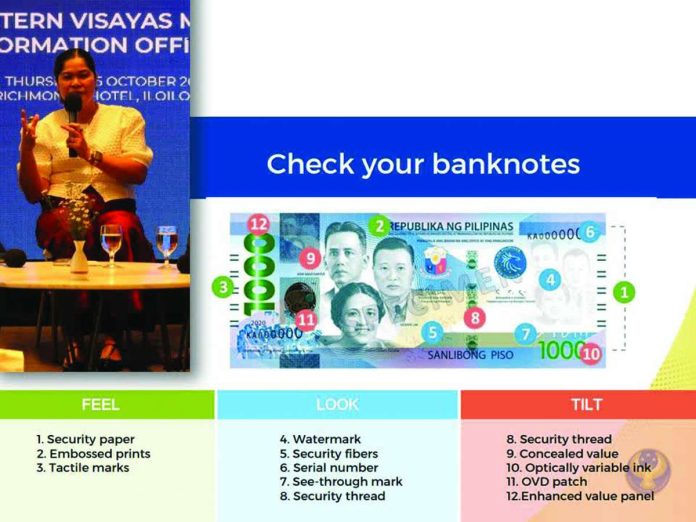
The central bank is promoting its “Feel-Look-Tilt” authentication method, a three-step procedure designed to help ordinary consumers and business establishments distinguish genuine banknotes from counterfeit currency.
“How do we identify genuine from counterfeit notes? Para hindi tayo ma-scam, dapat we are aware kung ano ba talaga ang genuine against the counterfeit,” says Oville stressed during a public awareness briefing.
BSP defines counterfeit currency as an imitation of genuine banknotes or coins intended to deceive people into accepting them as legal tender.
Oville said consumers should develop the habit of examining banknotes before accepting them, particularly during busy shopping periods when hurried transactions could make counterfeit money more difficult to detect.
“Basically, if may pera kayo, you have to touch. That’s the paper, pero ang polymer plastic, smooth. Look — tingnan mo ‘yung mga features ng pera and the reverse side: flora and fauna, and makikita mo ang color. And tilt — may mga security features talaga when tilted,” she added.
THREE STEPS TO SPOT FAKE BILLS
Under the BSP’s authentication guidelines, the first step, “Feel,” involves checking the texture of a banknote and identifying raised printing and other tactile security features.
Genuine Philippine paper banknotes are manufactured using a special blend of 80 percent cotton and 20 percent abaca, giving them a distinctive rough and sturdy texture.
Polymer banknotes, meanwhile, have a smoother plastic surface but contain security features that distinguish them from counterfeit copies.
Consumers are advised to run their fingers over printed elements, including portraits, denomination figures and the words “REPUBLIKA NG PILIPINAS,” to detect raised ink.
The second step, “Look,” requires examining banknotes against a light source to identify watermarks, embedded security fibers, serial numbers and see-through features.
Genuine paper bills contain watermarks showing the featured portrait and denomination, along with small red and blue security fibers.
Polymer banknotes feature transparent windows with intricate designs, including images of the Sampaguita flower and Philippine eagle.
The final step, “Tilt,” involves angling the banknote to observe security features that change color or appearance under different lighting conditions.
These include security threads, color-shifting ink, holographic patches and enhanced value panels found in certain denominations.
The BSP emphasized that understanding these features can help consumers recognize suspicious banknotes before completing cash transactions.
DO NOT SPEND SUSPECTED FAKE MONEY
The central bank also warned the public against knowingly passing counterfeit bills to other individuals or establishments.
Anyone receiving a suspected counterfeit banknote should refrain from spending it and, whenever possible, record information about where and from whom the money was obtained.
Suspected fake bills should be surrendered to the nearest police station, commercial bank or BSP regional office for technical examination.
The BSP continues to coordinate with local government units, retail associations and law enforcement agencies to prevent the circulation of counterfeit currency.
BSP-Iloilo and local financial institutions are also conducting information sessions to educate consumers and market vendors about the security features of genuine Philippine banknotes.
COUNTERFEITERS FACE HEAVY PENALTIES
The BSP reminded the public that counterfeiting Philippine currency and knowingly circulating fake banknotes are serious criminal offenses punishable under existing laws.
Under Article 166 of the Revised Penal Code, as amended by Republic Act No. 10951, forging or counterfeiting Philippine banknotes carries a prison term of 12 years and one day to 14 years and eight months, along with a fine of up to P2 million.
Knowingly possessing or using counterfeit money with intent to defraud is likewise punishable under Article 168 of the Revised Penal Code.
The BSP’s Payments and Currency Investigation Group is tasked with helping safeguard the integrity of Philippine currency and investigating currency-related offenses./PN