


BY GEROME M. DALIPE IV
ILOILO City – “Can I demand from my parents to send me to a prestigious school?”
This was among the legal questions raised by the students from the Iloilo Science and Technology University (ISAT-U) La Paz campus during a forum on legal rights with the Public Attorney’s Office (PAO) in this city.
The legal forum dubbed “Pangape-ngape with Attorney” tackled various legal questions about the students’ daily encounters with the law.
Lawyer Anne Servando, of the Public Attorney’s Office (CPA) in Iloilo City, said that support as provided in the Philippine Family Code is not absolute. “There is a reasonable circumstance on what extent the parents could extend,” Servando told the students.
Lawyer Helen Joyce Estiva, CPA, of the Public Attorney’s Office (CPA) in this city, said the State provides free education to all up to tertiary level, although such is subject to the availability of allocation for each school.
Lawyer Quennie Marie Villanueva-Solidum said that although the law mandates the parents to support their children, such assistance may vary depending on the capacity of the parents.
Article 194 of the Family Code provides that “support comprises everything indispensable for sustenance, dwelling, clothing, medical attendance, education, and transportation, in keeping with the financial capacity of the family.”
The same provision adds: “The education of the person entitled to be supported referred to in the preceding paragraph shall include his schooling or training for some profession, trade or vocation, even beyond the age of majority. Transportation shall include expenses in going to and from school, or to and from place of work.”
While the law recognizes the right of the individual to be given support, however, such right may not be demandable unless it is made via extra-judicially proceedings.
In addition, Article 203, paragraph of the Family Code states that “the right to demand support arises from imperative necessity.”
Hence, without the same, it cannot be demanded, and the law presumes that such necessity does not exist unless support is demanded, the Supreme Court ruled in the case of Jocson, et al. vs. Empire Insurance Co., et al.
This means that, under the Family Code, child support is considered an imperative necessity – which means the parents are legally obligated to provide support to their children, thus failure to do so could result in legal consequences.
However, the law provides that the amount of support is determined based on various factors such as the needs of the child and the financial capacity of the parents.
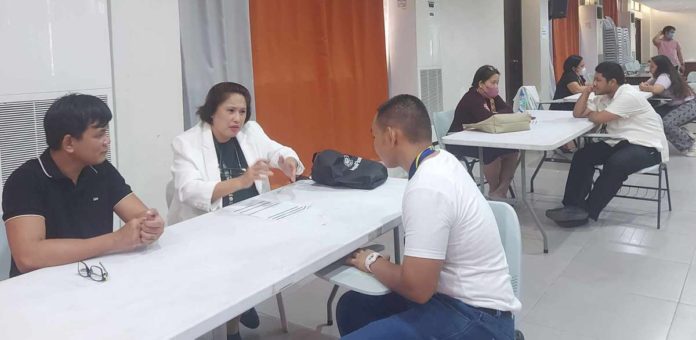
Apart from support, the student forum also tackled various legal rights and issues relevant to their lives. The students were also able to avail themselves of free legal consultation from the PAO lawyers.
These include issues on academic dishonesty, plagiarism, academic freedom, rights of physically-enabled students, physical and sexual abuses in school, copyright infringement, and students who wish to pursue the study of law after completing their graduate studies.
Estiva advised students who experience sexual abuse to report the incident to the school administration or directly with the child and women’s action desk at the police station.
Among the questions raised during the forum was the interest of some students to study law after graduating from college.
Servando said studying law requires commitment because one is studying not merely to pass law school, but to pass the bar.
“It will challenge your person and your pocket. You need not have Latin honors. You have to have sustainability,” said Servando.
Solidum said a law student need not be an excellent student, but he must be consistent and resilient in pursuing such a profession.
Apart from PAO lawyers, certified law student practitioners from the Central Philippine University College of Law also attended the legal forum, including Boots Arroz, Lornajane Altura, Hubert Canto, and this author.
The legal forum also aimed at highlighting the importance of education and awareness surrounding the legal rights of the students and the public.
The forum seeks to provide a platform for individuals to share knowledge, seek advice, and collectively empower one another in navigating the complex landscape of the law.
The legal forum also provided students with basic knowledge of basic legal rights to enable them to contribute to a more informed and resilient society where individuals are equipped to assert their legal rights with confidence.
Under its mandate of providing free legal assistance to indigent Filipinos, PAO is actively conducting legal education and outreach programs to various stakeholders as one of its key functions.
The PAO is involved in legal education and outreach programs to raise awareness about legal rights and responsibilities. This includes conducting seminars, workshops, and other initiatives to empower communities with legal knowledge./PN