


ILOILO City – This city has surpassed the national dentist-to-population benchmark and is now doubling down on preventive oral health programs, positioning itself as one of the few local governments with a stronger-than-required dental manpower ratio while aggressively pushing residents to shift from “pain-based” consultations to routine checkups.
The Iloilo City Health Office (CHO) reported that the city currently has 16 dentists under its Dental Division, with 15 deployed across the nine districts — a figure that places the city well ahead of the national target ratio of one dentist for every 53,000 people.
“At present, we have 16 dentists in the City Health Office. Fifteen of them are assigned in the districts — two dentists per district — except City Proper 1 and City Proper 2, which have one dentist each because their populations are smaller,” said Dental Division Head Revielynne Joy Dela Cruz.
She emphasized that Iloilo City’s estimated 2025 population of around 460,000 translates to roughly one dentist for every 35,000 residents — significantly better than the national benchmark.
“The national target is one dentist for every 53,000 population. That is actually very high. But here in Iloilo City, if we divide our estimated 2025 population of around 460,000 by our district dentists, our ratio is about one dentist for every 35,000 residents,” she said. “So we can say that, in terms of numbers, Iloilo City has enough dentists to cater to its residents.”
From extraction mindset to prevention culture
While manpower is sufficient, Dela Cruz said the bigger battle is changing long-held public behavior — particularly the tendency of patients to visit clinics only when they are already suffering from severe toothache.
“Our clinic-based services focus on treatment. But we also have strong school-based and community-based programs because we want to prevent dental problems before they start,” she said.
“Usually, people go to the clinic only when they have toothache. But we want them to be aware that it is better to visit the dentist at least twice a year, even if there is no pain, so we can detect problems early,” Dela Cruz added.
Age-specific programs
The CHO has rolled out life-stage-specific oral health programs, targeting pregnant women, infants, children, adolescents, adults, and senior citizens.
“We target everyone — pregnant women, babies, children, adolescents, adults, and senior citizens — because oral health concerns are different at every stage of life,” she said.
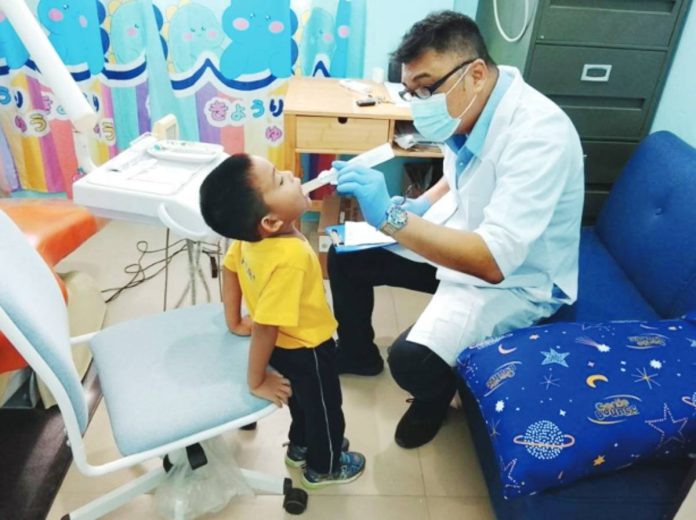
Daycare children receive annual dental checkups, fluoride application, and toothbrush drills in coordination with the City Social Welfare and Development Office.
“All our dentists are assigned specific daycare centers. Every year, children undergo dental checkups, fluoride application, and toothbrush drills,” Dela Cruz said. “We also distribute toothbrushes and oral health kits for home use so that good habits are reinforced.”
Kindergarten and Grade 1 pupils in Department of Education schools are also covered under school-based oral examination and orientation programs.
The city has recently intensified its focus on adolescents, citing self-esteem concerns linked to dental problems.
“We recently added a special focus on adolescents,” Dela Cruz said. “Some teenagers lose confidence because of dental problems. They do not smile, they avoid talking. We want them to understand that good oral health contributes to self-esteem and confidence, not just appearance.”
Oral health beyond the mouth
Dela Cruz stressed that oral health is closely linked to overall health, noting that many systemic diseases may manifest early signs in the mouth.
“Many diseases can first show signs in the mouth. Oral health affects other parts of the body,” she said. “The good news is that most oral diseases are preventable.”
She urged residents to adopt simple preventive practices.
“Brush your teeth twice a day with fluoride toothpaste, clean your gums, and maintain good oral hygiene. Fluoride has strong evidence that it helps strengthen teeth,” Dela Cruz said.
She also reframed the public’s perception of dental services.
“The mindset should not be that dentists are only for tooth extraction. Dentists are your partners in overall health,” she said.
Free dental checkups and basic services remain available at district health centers, with regular schedules observed by district dentists.
“Our dentists have regular schedules and are ready to serve. They are very hardworking,” Dela Cruz said. “We encourage residents to visit their nearest district dental clinic and take advantage of these services.”/PN