



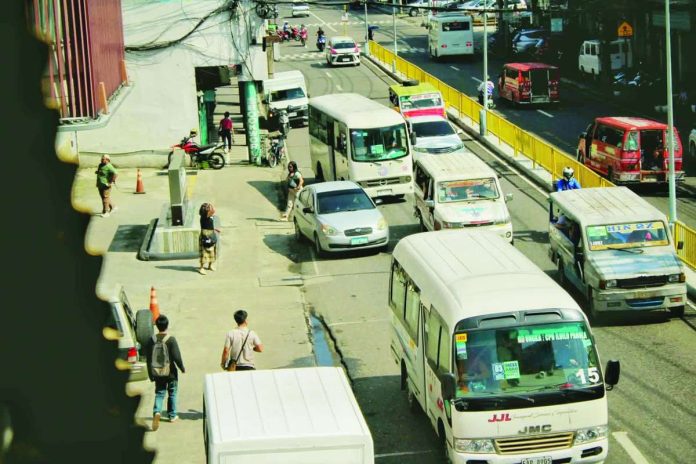
ILOILO City – The government’s public transport modernization program faces a major financial hurdle. The Department of Transportation (DOTr) secured only P176 million, or 10 percent of its P1.76-billion funding request, raising serious questions about its ability to protect drivers’ livelihoods while implementing sweeping transport reforms.
The massive P1.584-billion funding shortfall emerged as the World Bank proposed a major shift in the Public Transport Modernization Program (PTMP), replacing its emphasis on vehicle modernization with a service-based payment system designed to provide operators with predictable earnings and commuters with more reliable transportation.
The proposals were discussed during the Public Transportation Modernization Convention on October 13 at Diversion 21 Hotel in Iloilo City, where cause-oriented groups protested the modernization program over fears of displacement, mounting financial obligations and the possible monopolization of public transport.
DOTr Assistant Secretary Dioscoro Reyes acknowledged the government’s limited financial resources, saying the department received only P176 million of its proposed P1.76-billion budget for the program.
The funding constraints cast uncertainty over the government’s capacity to provide livelihood assistance to displaced transport workers, implement route reforms and sustain the proposed payment system for operators.
Under the World Bank proposal, the government would compensate participating transport operators based on the services they deliver rather than leaving them entirely dependent on daily passenger collections.
World Bank senior transport specialist Bowen Wang said the proposed changes would fundamentally redefine the modernization program’s objectives.
“Focus on modernizing the service, in terms of commuter experience, reliability, punctuality, headways, and availability,” Wang said.
The proposed gross cost-service contracting system would allow qualified operators to receive payments based on their compliance with prescribed operating standards, including punctuality, service availability and reliability.
“Essentially, what this does is, the government would pay the services provided by the operators and drivers based on their performance, and by doing that, alleviating them from the ridership risk and competition,” Wang explained.
Under the existing arrangement, operators shoulder vehicle expenses while their earnings fluctuate according to passenger demand.
This often encourages drivers to compete for passengers, wait until vehicles are full before departing and concentrate operations during peak hours, leaving commuters with unreliable services during less profitable periods.
Wang said the proposed system could particularly benefit operators who had already purchased modern jeepneys but were struggling to repay their loans.
“All of those who have bought modern fleets will enter this gross cost-service contract where they focus on providing service and then they get guaranteed payment,” he said.
“They can then use this guaranteed income to serve their debt and pay back to the bank,” he added.
However, the proposal remains subject to questions over eligibility, contract allocation, performance standards and the government’s ability to guarantee timely and sustainable payments.
ROUTE REFORMS TAKE PRIORITY
Meanwhile, Reyes said the DOTr would prioritize the Local Public Transport Route Plan (LPTRP) and route rationalization before proceeding with other modernization components.
“We prioritize what is the most basic need na kailangan ng may i-correct, and that is our LPTRP (Local Public Transport Route Plan) and route rationalization. But we cannot remove any or part of the component because it should be sequential,” Reyes said.
Route rationalization seeks to reorganize public transport operations according to passenger demand, reducing excessive competition along heavily traveled corridors while extending services to underserved communities.
The department identified three categories of routes: primary, less-developed and developmental.
Primary routes generally attract more operators because of higher passenger volumes, while less-developed and developmental routes often struggle to attract transport providers because of limited earning opportunities.
“All TSEs (transport service entities) don’t want to go to less developed routes, or especially the developmental routes. That is the beauty of the new proposal,” Reyes said.
Under the proposed arrangements, TSEs could be reassigned to routes where additional services are needed.
Reyes acknowledged that implementation would require cooperation among operators and transport organizations.
“We do not want to be ruled by the tyranny of the few,” he said.
The DOTr maintained that modernization also seeks to improve passenger safety, accessibility and comfort while reducing pollution associated with aging public utility vehicles.
However, transport groups remain concerned that consolidation requirements, expensive modern vehicles and possible route reassignments could threaten the survival of small operators.
The department said training and limited financial assistance were available for affected drivers and operators seeking alternative livelihoods, although the program’s funding limitations could restrict the extent of such support.
ILOILO CITY ROUTE PLAN UP FOR REVIEW
Against these developments, Iloilo City is preparing to review its approximately six-year-old public transport route plan to address changing commuter demand, population growth and emerging transportation requirements.
City Legal Officer Atty. Joseph Edward Areño said the existing LPTRP needed updating to reflect the city’s expanding urban activities and increasing daytime population.
“Kay ang aton number one purpose is for the riding public to have an efficient, effective kag magkomportable nga pagsakay sa dalanon kag magka-develop kita sang bag-o nga ruta,” Areño said.
He cited the growing number of students and workers traveling to Iloilo City from neighboring municipalities and provinces, particularly during weekdays and the school year.
“There are more students coming in and there are figures nga nagasiling nga ang aton nga population during weekdays and during classes naga-swell up to how many thousands. Then they are from other provinces and municipalities. So it’s about time nga aton i-review ang aton LPTRP,” he said.
Areño said data gathered through the SWED fund, particularly on daytime population and rush-hour passenger demand, would help determine which existing routes require additional vehicles and where new routes should be established.
The city is considering preparing a revised route plan for submission to the Iloilo City Council following broader consultations with stakeholders.
The review is expected to play an important role in aligning the national modernization program with Iloilo City’s actual transportation requirements.
LIVELIHOODS AT STAKE
The proposed reforms come amid persistent opposition from transport groups that fear modernization could displace small operators and concentrate public transport operations in the hands of financially stronger entities.
Although the World Bank’s service-based contracting proposal promises more predictable earnings, questions remain over whether small operators would have equal opportunities to participate and whether government funding would be sufficient to sustain the arrangement.
The P1.584-billion gap between the DOTr’s requested and approved funding underscores the financial challenge confronting the program.
For Iloilo’s transport sector, the central issue is whether modernization can deliver more dependable public transportation without forcing drivers and small operators out of business.
The outcome will depend on how the government addresses funding limitations, protects existing livelihoods and ensures that the proposed reforms benefit both commuters and transport workers./PN