

[av_one_full first min_height=” vertical_alignment=” space=” custom_margin=” margin=’0px’ padding=’0px’ border=” border_color=” radius=’0px’ background_color=” src=” background_position=’top left’ background_repeat=’no-repeat’ animation=”]
[av_heading heading=’ ABOVE THE LAW ‘ tag=’h3′ style=’blockquote modern-quote’ size=’30’ subheading_active=’subheading_below’ subheading_size=’15’ padding=’10’ color=” custom_font=”]
BY AYIN DREAM D. APLASCA
[/av_heading]
[av_textblock size=” font_color=” color=”]
Monday, October 16, 2017
[/av_textblock]
[av_textblock size=’18’ font_color=” color=”]
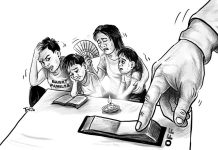
THERE is chaos already. The communist rebels have waged war for almost 50 years. Thus, the President is not hesitant to declare a revolutionary government until the end of his term. Worse, he will arrest all who go against him. Additionally, he will go to a full-scale war against the Reds.
Scared?
Well, from the first word itself, there is really something to be scared of. However, there are also people who support this move. What do you think? What is really a revolutionary government?
When we say “revolutionary” or “revolution”, it means that there is fundamental change in political power or organizational structures. It takes place in a comparatively short period of time when the people rise up in revolt against the established government.
In the landmark case Republic of the Philippines vs. Sandiganbayan, et. al. (G.R. No. 104769, July 21, 2003), the Supreme Court says “a revolution has been defined as the complete overthrow of the established government in any country or state by those who were previously subject to it or as a sudden, radical and fundamental change in the government or political system, usually effected with violence or at least some acts of violence.”
The case also added that “the resulting government was indisputably a revolutionary government bound by no constitution or legal limitations except treaty obligations that the revolutionary government, as the de jure government in the Philippines, assumed under international law.”
From the natural law point of view, the right of revolution has been defined as an inherent right of a people to cast out their rulers, change their policy or effect radical reforms in their system of government or institutions by force or a general uprising when the legal and constitutional methods of making such change have proved inadequate or are so obstructed as to be unavailable. It has been said that the locus of positive law-making power lies with the people of the state and from there is derived the right of the people to abolish, to reform and to alter any existing form of government without regard to the existing constitution.
However, in a revolutionary government, the circumstances are not always drastic and radical. How?
It still has the duty to insure that no one shall be subjected to arbitrary or unlawful interferences with his or her privacy, family, home or correspondence. It could not escape responsibilities for the State good faith compliance with its treaty obligations under international law.
Nonetheless, it is something that cannot be decreed outside the context of an actual revolution. There must be first a revolution because a revolutionary government is the result of a revolution. Thus, in order for the President to become a leader of a revolutionary government, there must be an insurgency – a rebellion.
We cannot predict what will happen next. Because having a dictator is always a dangerous plan – no matter how benevolent and nonthreatening. Making a move on this needs a big kick of trust and confidence.
(Atty. Ayin Dream D. Aplasca practices her profession in Iloilo City. She may be reached thru ayindream.aplasca@gmail.com/PN)
[/av_textblock]
[/av_one_full]