

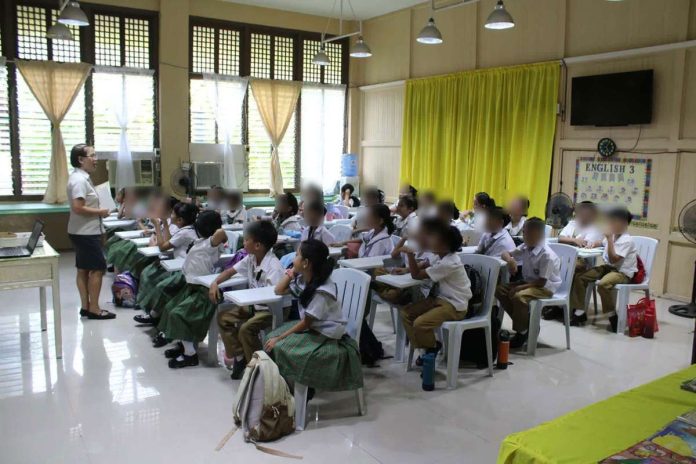
ILOILO City — The Department of Education (DepEd) Region 6 vowed a smooth implementation of the new three-term school calendar, intensify efforts to improve learning quality, and strengthen school support systems as over 745,000 learners across Western Visayas return to classrooms for School Year 2026-2027.
Regional Director Cristito Eco said the opening of classes marks a crucial phase in DepEd’s drive to deliver better educational outcomes while ensuring that every learner receives quality, inclusive, and accessible education.
A major initiative this school year is the implementation of a three-term school calendar, which DepEd said is designed to provide a more balanced learning schedule and improve student outcomes.
Under DepEd Order No. 009, series of 2026, the school year opened on June 8 and would end on April 8, 2027, with 201 class days divided into three academic terms and two-week enrichment blocks intended for remediation, assessment, and focused learning support.
“We are committed to ensuring its smooth and effective rollout. This structure is designed to provide a balanced distribution of learning time, allowing learners to better attain the required competencies while also considering their well-being,” said Eco.
The DepEd Three-Term School Calendar is not the same as the traditional “trimester” system commonly used in colleges and universities. A traditional trimester system in college usually divides the academic year into three equal semesters where subjects may be compressed, rotated, or completed within one term. In some cases, students take different sets of subjects every trimester.
In contrast, the DepEd Three-Term School Calendar does not change the curriculum structure, subject offerings, or learning competencies. Basic Education will continue to follow the same curriculum standards and subjects prescribed under DepEd. The reform simply reorganizes the school year into three academic terms to improve instructional pacing, reduce disruptions, and provide dedicated periods for assessment, remediation, and enrichment.
“Through careful planning and coordinated efforts, we aim to maximize instructional time and improve learning outcomes throughout the school year,” said Eco.
The implementation will primarily apply to public elementary and secondary schools, including Senior High School, while private schools may opt to retain their existing academic calendars provided they comply with DepEd policies and required school days.
Improving education, Eco added, goes beyond simply increasing school access, he said, stressing the need to strengthen classroom instruction, provide adequate learning materials, and continuously enhance teachers’ capabilities.
“We place utmost priority on the assurance of quality basic education. This means strengthening our teaching and learning processes, ensuring the adequacy of instructional resources, and continuously building the capabilities of our educators,” Eco said.
“We recognize that quality education is not merely about access, but also about meaningful learning experiences that equip our learners with the competencies they need to thrive in a rapidly changing world,” he added.
The regional education chief also underscored the importance of collaboration among local government units, private organizations, non-government groups, and community stakeholders in addressing the needs of schools and learners.
“The success of our schools does not rest on the Department alone; it is a shared responsibility. Thus, we will continue to actively tap and expand our partnerships with local government units, private sector organizations, non-government organizations, and community stakeholders. Together, we can provide more opportunities, resources, and support systems that will ultimately benefit our schools and learners,” Eco stressed.
Eco urged education stakeholders to remain united in pursuing the shared goal of providing quality education to every Filipino learner.
“As we begin this new school year, let us remain steadfast in our shared vision of providing every Filipino learner with quality, inclusive, and accessible education,” he emphasized.
“DepEd Region 6 will not rest on its laurels. Rather, we will continue to find more ways to ensure that no child will be left behind, to provide conducive learning spaces, to deliver improved quality of basic education, and to guarantee that every Champion learner is afforded the education that he or she truly deserves from their Department of Education,” he added.
Eco expressed optimism for the school year ahead: “Thank you to everyone involved in this noble endeavor. Together, let us make School Year 2026-2027 productive and meaningful for all our learners.”
As of June 8, DepEd-6 recorded 745,107 learners enrolled across Western Visayas, including 339,025 in Iloilo province, 97,729 in Capiz, 84,955 in Aklan, 80,951 in Antique, 61,862 in Iloilo City, 36,214 in Guimaras, 24,566 in Roxas City, and 19,805 in Passi City./PN