

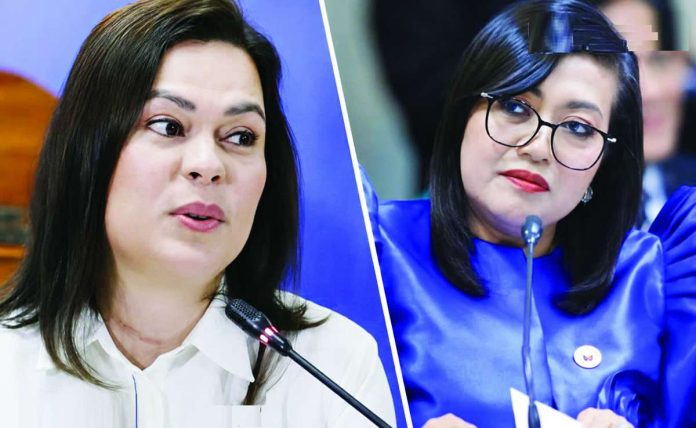
MANILA — The Senate impeachment court on Tuesday allowed House prosecutors to withdraw three impeachment charges against Vice President Sara Duterte-Carpio, narrowing the historic trial to questions only surrounding her assets and financial disclosures.
The decision leaves prosecutors pursuing allegations that Duterte-Carpio failed to properly declare assets in her Statement of Assets, Liabilities and Net Worth (SALN) and divest herself of business interests as required under constitutional restrictions.
The prosecution had earlier cited findings suggesting that the Vice President and her husband, lawyer Manases Carpio, accumulated between P817 million and P1.5 billion in allegedly unexplained wealth.
Senate President Francis Escudero, presiding over the impeachment court, approved the prosecution’s request despite objections from Duterte-Carpio’s defense team, which warned that abandoning charges after evidence had already been presented could violate her right to due process and potentially result in a mistrial.
“The court accepts and confirm the prosecution’s manifestation,” Escudero said.
The ruling followed an announcement by lead House prosecutor and Batangas’ Cong. Gerville Luistro that the prosecution would concentrate exclusively on Article II, involving unexplained wealth, rather than continue pursuing all four articles of impeachment.
“Today, the prosecution respectfully manifests that it will no longer pursue three of them. It will stand on one and that is Article II on unexplained wealth,” Luistro said.
Under the revised prosecution strategy, Article I, involving the alleged misuse of confidential funds allocated to the Office of the Vice President and Department of Education, will no longer be pursued.
Also withdrawn were Article III, accusing Duterte-Carpio of bribing Department of Education officials, and Article IV, involving alleged grave threats against President Ferdinand Marcos Jr. and his family, an assassination plot, and inciting to sedition.
Despite abandoning these charges, Luistro insisted that the prosecution had gathered sufficient evidence to establish grounds for Duterte-Carpio’s removal from office.
“All in po tayo. We believe that evidence is substantial and compelling and warrants the respondent’s removal from office for culpable violation of the Constitution and betrayal of public trust,” Luistro said.
The decision came after weeks of impeachment hearings during which prosecutors presented testimony from officials of the Anti-Money Laundering Council, representatives of banks and insurance companies, and lawyer-accountant Alexander Cabrera.
Their testimonies formed part of the prosecution’s effort to establish alleged discrepancies between Duterte-Carpio’s declared assets and the wealth purportedly accumulated by her and her husband.
However, the Vice President’s defense team questioned the fairness of allowing prosecutors to abandon allegations after presenting evidence that Duterte-Carpio had yet to fully challenge.
Lead defense counsel Sheila Sison argued that the withdrawal could leave damaging accusations on the trial record without giving the defense sufficient opportunity to rebut them.
“The prosecution would thus retain the benefit of having its evidence heard while the respondent would be at risk of being denied the benefit of having that evidence contradicted, and we feel and believe that this is not fairness and it is not keeping with the guarantees of due process because the right to be heard is not merely satisfied by allowing the respondent some room to present evidence on her behalf,” Sison said.
She warned that the prosecution’s attempt to streamline the proceedings could result in a “mistrial” if Duterte-Carpio’s constitutional right to defend herself against the allegations were compromised.
Sison cited the impeachment trial of former chief justice Renato Corona, during which prosecutors withdrew five articles before presenting evidence on them.
She emphasized that Duterte-Carpio’s case was different because prosecutors had already introduced evidence concerning two of the three charges they now wanted withdrawn.
Luistro, however, invoked the same Corona impeachment proceedings to defend the prosecution’s authority to determine which allegations it would continue pursuing.
Escudero clarified that neither side had absolute authority over the withdrawal of impeachment charges once the articles had been transmitted to the Senate for trial.
“It is not solely the prosecution’s call to withdraw an article of impeachment, but neither is it the respondent’s call to deny the same,” Escudero said.
He explained that the filing of the impeachment articles placed the proceedings under the Senate court’s jurisdiction, making its approval necessary before any charge could be withdrawn.
The narrowing of the case represents a major shift in the prosecution’s strategy, effectively making Duterte-Carpio’s financial disclosures and the allegations surrounding her family’s wealth the central issues in determining whether she should be removed from office.
However, the withdrawal of the three articles does not constitute a finding that the allegations were false, just as the continuation of the unexplained wealth charge does not establish the Vice President’s guilt.
The impeachment proceedings were adjourned to allow senators to concentrate on deliberations over the proposed P7.2-trillion national budget for 2027.
The trial is expected to resume in November, when Duterte-Carpio’s defense team will begin presenting evidence and witnesses to challenge the remaining impeachment charge./PN