



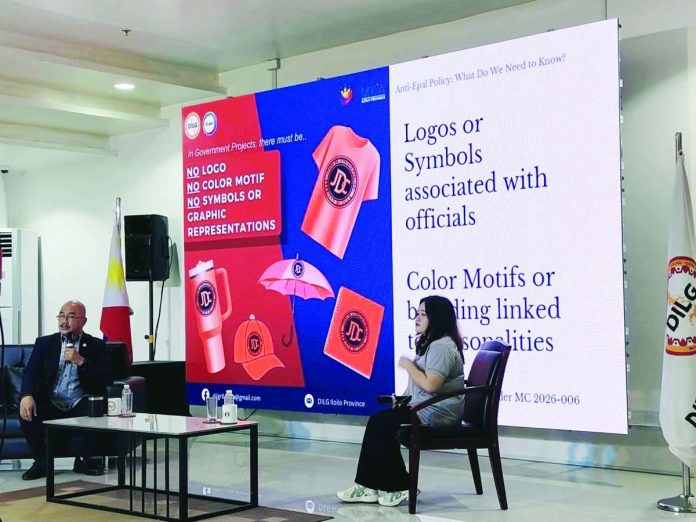
ILOILO City — The Department of Interior and Local Government (DILG) in Western Visayas has intensified its call for public vigilance in enforcing the Anti-Epal Policy after receiving 18 reports of alleged violations in just two months, while noting that most local government units (LGUs) are already moving toward compliance.
Regional Director Juan Jovian Ingeniero said citizen reports — many sourced from social media — have become critical in flagging officials who continue to attach their names and images to government-funded projects, a practice now prohibited under DILG Memorandum Circular 2026-006.
“May nagko-complain through email. Ang aming regional legal office ang nagko-collate ng lahat ng complaints,” Ingeniero said.
The reports — covering various LGUs across Region 6 — are being consolidated and forwarded to the DILG central office for legal evaluation and possible action, including policy refinements based on public feedback.
Ingeniero emphasized that the Anti-Epal Policy seeks to reinforce accountability by ensuring that public projects remain institution-centered rather than personality-driven.
“This policy, which was implemented just two months ago, is about fostering accountability in governance,” Ingeniero explained. “It shifts the focus from personal accolades to institutional achievements.”
He added that the policy strictly prohibits the display of names, images, and likenesses of public officials on government-funded infrastructure and programs, stressing that such projects are financed by taxpayers.
“DILG Memorandum circular 2026-006 is commonly known as the Anti-Epal Policy, Prohibition on the Display and/or Affixture of the Name, Image and Likeness of Public Officials on Government Projects. What we are doing now is strengthening and institutionalizing its implementation across all levels,” Ingeniero said.
Despite the reported violations, the DILG-6 noted a generally positive response from LGUs, with many local officials voluntarily removing personal promotional materials from public spaces.
“While we strive for full compliance, it’s worth noting that the majority of LGUs are making significant strides. Many mayors are actively removing their images from congratulatory messages and other public displays, emphasizing a commitment to the Anti-Epal Policy,” said Ingeniero.
He reiterated the core principle behind the policy: “It’s message is simple yet powerful: Government projects are funded by people, therefore credit must belong to the
The DILG encouraged the public to continue submitting reports and suggestions to further strengthen the policy.
“We believe that this initiative is dynamic, not static. The government welcomes constructive suggestions from the public, as some reports include recommendations that may enhance the policy,” Ingeniero said.
He added that visible violations are immediately flagged by the regional office, prompting swift action from LGUs.
Although specific details of the 18 reports were not disclosed, DILG-6 assured that all cases have been endorsed to the central office for appropriate action./PN